ARSA’s 2015 Annual Repair Symposium provided attendees two jam-packed days of presentations, speakers and panels covering a broad range of regulatory and industry issues.
Executive Director Sarah MacLeod and Executive Vice President Christian Klein kicked things off by highlighting some of the association’s legislative and regulatory successes over the past year. During the symposium’s “Opening Salvos,” regulators from the FAA and EASA addressed the varying procedures between the two regulatory systems, the effect that non-conformity has on the global aviation maintenance industry and the need for strong bilateral agreements.
Representatives from ARSA’s sister associations provided the resounding message that the aviation community must work together as politicians and regulators make policy decisions that will ripple through a global industry. Technological innovation and the FAA’s role in collecting maintenance data also took center stage when agency representatives introduced the newest data exchange program and solicited feedback from attendees. The first day came to a close with a message from Kevin Hiatt of the International Air Transport Association (IATA) to emphasize the importance of the ARSA-IATA relationship and the need to continue to engage internationally with trade groups and regulators.
ARSA’s President Jim Perdue began the symposium’s second day by providing his “state of the association” report to the annual member meeting. Perdue was followed by the Honorable Michael P. Huerta, FAA administrator, who gave an overview of the agency’s policy objectives and priorities for the coming year and fielded questions from attendees. After hearing from the FAA’s top official, participants broke off to attend smaller sessions focusing on discrete issues ranging from negotiations of maintenance agreements (i.e., ICAs) and workforce development, to data reporting and best practices for interacting with the FAA. These smaller sessions provided a unique opportunity to interact with panelists and bring to light problems and concerns that impact individual businesses and touch the industry as a whole.
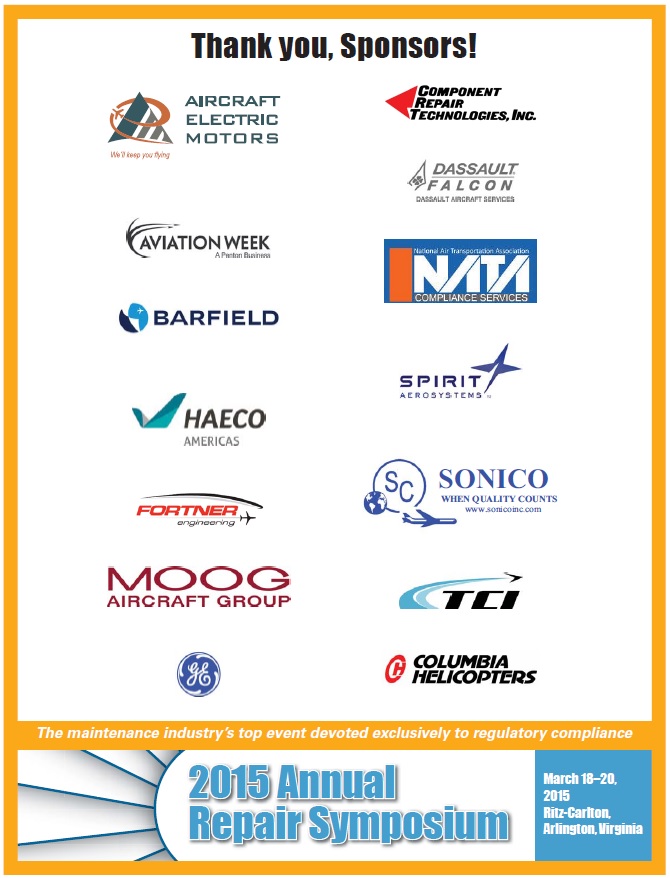
This year’s Symposium could not have succeeded without the help of the association’s sponsors and panelists. ARSA looks forward to next year’s symposium and will continue to vigorously advocate on behalf the aviation maintenance industry.
Get ready for 2016. The Annual Repair Symposium will return to Arlington, Virginia March 16-18, 2016. Have a topic you’d like to see explored in 2016? Click here to tell us about it.
Did you attend this year? Participant materials are available for download, contact ARSA for more information.
More from ARSA
November 20, 2026 | Categories:
Act Now,
ARSA News & Updates,
ARSA Works,
Aviation Policy,
Drug and Alcohol,
EASA,
FAA,
Legislative,
Operations,
Press Releases,
Regulatory,
Rulemaking
On Nov. 19, ARSA received a response to the industry petition requesting the FAA extend the compliance deadline for certain repair stations located outside the United States to institute drug…
Read More
ARSA’s training team analyzes the human factors contributing to maintenance failures associated with the June 10, 1990 explosive decompression of British Airways flight 5390.
The accident report stated that “as…
Read More
Multiple incentive programs funded by the U.S. Department of Labor could provide resources for aerospace maintenance employers.
In July, the government awarded nearly $162 million to five organizations to lead…
Read More
On Nov. 10, the Federal Register published the FAA’s final rule “Inspection Programs for Single-Engine Turbine-Powered Airplanes and Unmanned Aircraft; and Miscellaneous Maintenance-Related Updates.” Included in those “miscellaneous updates” are:
(1) Removal…
Read More
The association’s team returns for a full 20 minutes (and a few seconds) to talk about the “miscellaneous maintenance updates” in a recently issued FAA Final Rule removing the “current”…
Read More