


2025 – Edition 11 – December 5
Table of Contents
Note: The order of material varies in hotline emails, but is always presented the same on this landing page. Readers scrolling through content on or printing this page will find it organized consistent with the table of contents.
President’s Desk
Linking Up
ARSA’s communications team has returned to social media. No dances or challenges or meme sharing, not from this association, but the reactivation of a LinkedIn profile is another means for communications and connection to the aerospace community.
Click here to see the profile and follow ARSA’s updates.
Between three newsletters (click here to make sure you’re getting all that you can from these distributions), a website, trade press editorial placements, training sessions, and responses to general media inquiries, ARSA tells the aerospace maintenance industry’s story and informs its people in countless ways. The investment supporting those media pays off in awareness and attentiveness of association members and colleagues around the world.
 Digital connectedness demands taking advantage of chances for real, personal connection. With the opening of Conference registration, the time to plan for individual interaction at the aerospace community’s premier substantive event is here. Its form will be familiar with four days of engagement ranging from private executive meetings to expansive regulatory discussion. For those who’ve been before, the 2026 Conference will be a familiar expression of important substantive work. For first timers, the event will be an intense exposure to the continual compliance and advocacy work that is the focus of ARSA’s team all year.
Register now and plan to bring colleagues, specifically newer personnel looking to grow quality expertise.
Registration and sponsorship invoices can be paid before the end of the year – to use up 2025 money – or held until January. Hotel reservations are available at the Ritz Carlton, which hosts most Conference activities and provides ARSA a government rate for booking.
You should definitely “link up” with the association online. Once you’ve done that, plan to see it in human form in March.
 |
John Riggs 2025 ARSA president | Director of Airworthiness, Chromalloy |
Conference 2026
Register Now!
March 17-20, 2026
Event Information | Registration | Hotel
Arlington, Virginia and Washington, D.C. with Livestream Options for Online Participants
Experience the international aerospace maintenance community’s premier event. Join ARSA members and invited guests from around the world to engage governments, network with peers and improve the state of the aviation world.
Submit your registration right now!
Advertising – Time to Shine
Among the most enticing options available for ARSA supporters is Conference sponsorship.
Over the past decade, the Annual Conference has become a “who’s who” of maintenance industry leaders (visit the event page to see who stood up for ARSA in 2025…and learn how to join them). The companies that commit to the international maintenance community’s premier substantive event receive both visibility and immediate benefits in return for their investment.
Marketing – Sponsorship is highlighted in all ARSA communications for the first quarter of the year, including newsletters and on the Conference website. In January, all sponsor logos are added to the team’s email signatures; every message highlights those key supporters of the association’s work. Top level (Administratium, Platinum, and Gold) sponsors are thanked in member alerts. During the event, sponsors are thanked via signage and repeatedly “from the lectern” during presentations.
Event Access – Sponsors get complimentary registrations for the Executive-to-Executive Briefings on March 18 and Legislative Day on March 19. Top level sponsors get to participate in a “special invitation” dinner on March 19 after the IceBreaker reception. They also get free livestream access to the event and to the recordings after it is complete, so content can be shared with personnel that cannot make the trip to Washington.
Specific support – Each level has different elements of the Conference the sponsor can specifically support. During that portion of the event (or when the resource is mentioned) the sponsor is highlighted.
Special Opportunity – To get new sponsors in the door, the ARSA team has created special bundle pricing including a Silver Sponsorship and single registration to all elements of the Conference. Check out the event page for all pricing details.
Between advertising and sponsorship opportunities, ARSA has options for every type of business looking to invest in the international aerospace maintenance community while letting their own good work shine on the industry’s stage.
2026 Conference Sponsors will be announced in January. Click here to learn how to join them. Do so before New Year’s and the team will work with you to use 2025 or 2026 money (or both).
To learn more about ARSA’s advertising placements, click here.
Not interested in advertising? Don’t forget to send your news releases and other media information to arsa@arsa.org.
Planning Ahead
March 17-20, 2026
Event Information | Registration | Hotel
Arlington, Virginia and Washington, D.C. with Livestream Options for Online Participants
Help ARSA’s team put together the 2026 Annual Conference by answering a few questions.
If the embedded survey doesn’t load, click the following link to open it in a new tab: https://www.surveymonkey.com/r/ARSAConferencePlan.
ARSA Works
Support Simplifying New D&A Rules
On Nov. 26, ARSA submitted a petition for reconsideration of the denied industry effort to help the FAA simplify its new rule requiring drug and alcohol testing programs at repair stations located outside the United States. The agency rejected an August petition submitted by eight industry trade associations seeking to amend the regulatory language issued in December 2025 and scheduled to become effective by the end of 2027.
The original petition proposed 10 changes to simplify compliance, oversight, and enforcement. Despite the public’s interest in facilitating compliance for more than 1,000 certificated repair stations supporting American global operations, the FAA’s non-specific denial broadly noted the original petition failed to meet government criteria for immediacy, priority, and resource allocation necessary for rulemaking action. Seeking reconsideration, ARSA addressed each criterion.
(1) Immediacy of Safety Concerns
“Failing to revise part 120 as petitioned raises immediate safety concerns because foreign repair stations may decide to surrender their certificates rather than comply, reducing the availability of repair stations legally able to service U.S. registered aircraft and related articles outside the United States…Additionally, the inability of the agencies (i.e., the FAA and the Department of Transportation) to process waiver requests and petitions for exemptions in a timely and consistent manner will further strain the aviation maintenance safety assurance system.”
(2) Priority of Other Issues
“While the FAA may have determined foreign repair station D&A is a low priority, Congress considers the issue significant, as reflected by multiple reauthorization laws. The FAA prioritized issuance of the final rule; to facilitate efficient implementation, the agency must now similarly prioritize addressing challenges identified since the rule was finalized.”
(3) Available FAA Resources
“The petition for rulemaking was and is aimed at resolving enforcement and compliance challenges before foreign repair stations attempt to bring themselves into compliance. In evaluating the resources needed to amend part 120, the agency must consider the massive expenditure associated with processing sec. 120.9 and 120.10 waiver applications from more than a thousand foreign repair stations without amending the rule as suggested in the petition.”
ARSA seeks industry support for the ongoing effort. Click here to go to the rulemaking document (or search “FAA-2025-2498” on regulations.gov) and submit a comment in favor of the effort. Effective comments include specific examples/data supporting points made in the petition, including descriptions of safety and supply chain impacts caused by the rule.
To read the complete petition for reconsideration, click here.
To read the original August petition, click here.
To go to the rulemaking docket, click here.
For more analysis, see this month’s “Legal Brief.”
Product Support Survey for Maintenance Providers
ARSA has partnered with the International Air Transport Association (IATA) to survey the industry delegation under the Airbus or Boeing product support frameworks (Airbus Supplier Support Conditions – (SSC) and Boeing Product Support Assurance Agreement – (PSAA)). An additional survey targeted at air carrier personnel will follow.
In “Reviving the Commercial Aircraft Supply Chain,” co-released by the International Air Transport Association and Oliver Wyman in October 2025, these “contractual enablers” available to aircraft owners and operators (airlines) and their maintenance providers are an important tool for industry to address supply chain imbalances and build future resiliency.
Help both associations gather experiences with (and raise awareness of) these frameworks by completing this short survey. For more information, contact ARSA.
Note: These “delegations” are NOT those provided for and under 14 CFR. This survey tests the industry’s knowledge of delegations available to the airlines towards their contracted maintenance providers through the product support frameworks of Boeing (the PSAA) and Airbus (the SSC).
If the embedded survey (which may require scrolling to complete) does not appear or function, go to: https://www.surveymonkey.com/r/TCholderproductsupport.
Final Documents/Your Two Cents
This list includes Federal Register publications, such as final rules, Advisory Circulars and policy statements, as well as proposed rules and policies of interest to ARSA members.
From Our Friends
IATA PMA Adoption Webinar Recording Available
On Nov. 19, the International Air Transport Association’s (IATA) dedicated advisory group on “alternative aerospace materials” hosted a webinar reviewing the air carrier “practices and perceptions” revealed by the association’s survey on PMA adoption. That survey found that 74 percent of responding airlines used PMA parts to mitigate supply chain challenges. Cost savings and part availability were high priorities, with the vast majority of the parts used being consumables or furnishings, with limitations caused by lessor restrictions and supply limitations.
To read the complete Air Carrier PMA Survey report, click here. ARSA members should refer back to the “Legal Brief” in the September edition of the hotline (which hit inboxes on Oct. 3) and read Sarah MacLeod’s editorial in the Third Quarter edition of Aviation Maintenance Magazine to challenge their starting PMA knowledge by asking the question: “What is an OEM?”
For those wishing to see IATA’s survey results and learn more about its efforts to push alternative materials, the recording is now available (with access to the supporting slide deck).
IATA Webinar – Approved Alternative Parts
Description: As the aviation industry continues to face supply chain constraints and rising operational costs, the adoption of approved alternative solutions (parts, repairs etc.) is gaining momentum. This webinar will explore:
- The fundamentals of PMA (Parts Manufacturer Approval) and other approved alternative parts.
- The regulatory landscape as it pertains to approved alternative parts.
- The EU-USA Bilateral Agreement as it pertains to PMA parts.
- Industry trends and survey insights on adoption across airlines and MROs.
- Common misconceptions and barriers to acceptance.
- The impact of leasing agreements and OEM contracts; work in progress.
Recording Access: Click here or go to https://www.youtube.com/watch?v=fC_5YKx8Phk&feature=youtu.be.\
Materials Download (PDF): Click here.
Contact: Stephanie Lambrinakos-Raymond, Senior Manager Technical Operations Performance, OSS-Flight and Technical Operations, IATA
Legal Brief
Editor’s note: This material is provided as a service to association members for educational and informational purposes only. It does not constitute legal or professional advice and is not privileged or confidential.
A Petition in Time Saves Nine
By Christian Klein, Executive Vice President
The old saying “a stitch in time saves nine” means one precautionary step today can avoid nine extra steps to fix something in the future. Or as my Alsatian grandmother used to say (to me, often in frustration), “A lazy man always does twice as much work.” In other words, when you know you have a problem or task, deal with it now to save future headaches.
That’s the message in the petition ARSA filed Nov. 26 asking the FAA to reconsider its denial of an association-led rulemaking petition to fix the FAA’s foreign repair station drug and alcohol (D&A) rule. Since the D&A rule was published last December, ARSA has spent untold hours analyzing FAA and U.S. Department of Transportation (DOT) requirements, learning about D&A compliance requirements in other countries, educating industry and foreign governments about the new requirements, and developing materials to support waiver and exemption applications.
In the process, ARSA identified several opportunities to make compliance and oversight more efficient. Proposals to clarify which foreign repair stations must comply with the new D&A requirements and simplify the waiver processes formed the basis of the industry’s original rulemaking petition, which the FAA denied in October. The most reconsideration petition asked the FAA to reevaluate that denial in light of incorrect cost assumptions that formed the basis of FAA’s December 2024 rule and the agency’s misinterpretation of the law.
The FAA assumed that for a country to request a waiver for all its repair stations would equate to $2,569, an estimate that is belied by the number of hours it has taken ARSA to draft a waiver for a foreign government with laws and regulations fully compatible with those set forth in 14 CFR part 120.
Similarly, in the preamble to the final rule, the FAA said it assumed “that every foreign government that regulates part 145 repair stations located outside the territory of the U.S. will submit a request for a waiver based on recognition. There are 65 countries that have part 145 repair stations within their territories so there will be 65 submissions.” (Emphasis added.)
But many foreign governments are unaware of the requirement or the ability to obtain a waiver on behalf of the repair stations in their jurisdictions. Where awareness exists, the governments are unable to determine the appropriate department, agency, or authority through which the waiver would be requested as the issues involve privacy rights, health and safety laws and regulations, as well as civil aviation authorities. Additionally, for political reasons, or due to time and resource constraints, governments are disinclined to act or are simply refusing to submit a petition that meets the requirements of sec. 120.10.
For that reason, ARSA told the FAA it is much more likely that the agencies will be inundated by waivers and petitions from individual facilities, each of which will need to take a minimum of 80 to 100 hours to develop a potentially compliant program with an appropriate waiver and/or exemption request. It will take an equally extensive period for the FAA and DOT to review and process multiple, potentially conflicting applications. Determining compliance will take time and involve multiple federal agencies because there are regulatory requirements (e.g., the use of U.S. Department of Health and Human Services approved laboratories to process drug test specimens (See sec. 120.103(b)(2))) with which no foreign repair station can comply.
ARSA also said the FAA has failed to embrace the full authority Congress gave it to find foreign repair station D&A programs “acceptable to the administrator”. 49 U.S.C. sec. 44733(d)(2) directed the FAA to promulgate a rule to ensure certain foreign part 145 repair station employees are subject to an alcohol and controlled substances testing program deemed acceptable by the Administrator and consistent with the applicable laws of the country in which the repair station is located.
With that language, Congress recognized that it was impossible for foreign repair stations to fully comply with part 120 and 49 CFR part 40. Therefore, the law does not require foreign repair stations to have D&A programs that fully comply with DOT rules. Indeed, in providing the FAA with discretion to waive DOT requirements inconsistent with a foreign country’s laws. And by creating the 14 CFR sec. 120.10 waiver process, the FAA recognized that full compliance with 49 CFR part 40 is not required under the law.
As such, ARSA argued, the FAA should more aggressively assert its authority to waive impracticable DOT D&A requirements (e.g., the use of U.S. Department of Health and Human Services approved testing labs, which only exist in the United States and Canada) so foreign repair stations do not have to separately petition the FAA for a waiver and the DOT for exemptions.
ARSA is committed to the highest level of safety by the most efficient means possible. We’re hopeful the FAA will reconsider the opportunities industry has identified to fix the D&A rule and expend some rulemaking resources now to save the industry and agency from a massive and unnecessary diversion of resources in the future.
ARSA on the Hill
Patriotism vs. Profits
By Christian Klein, Executive Vice President
ARSA’s advocacy for maintenance data access is well-known. For decades the association has fought to equalize FAA’s enforcement of its instructions for continued airworthiness (ICA) rules. In recent years, ARSA has also lobbied to improve access to maintenance information for aircraft and other systems purchased by the U.S. Department of Defense (DoD).
DoD (like far too many commercial air carriers) does a poor job of negotiating data access rights when entering purchase contracts. As a result, DoD suppliers assert intellectual property rights or claim maintenance information is protected as manufacturing and process data to justify withholding it from the government and third parties. That makes it difficult for DoD to competitively bid maintenance contracts.
ARSA has long been a lone voice in the wilderness, but recently an unlikely pair of allies emerged as champions of data rights on Capitol Hill: Sens. Elizabeth Warren (D-Mass.) and Tim Sheehy (R-Mont.). Their Warrior Right to Repair Act (S. 2209) they introduced in July 2025 would require contractors to provide DoD with access to technical data and materials the military needs to repair and maintain its own equipment. Parallel legislation (H.R. 5155) was introduced in the House in September 2025 by Reps. Gluesenkamp Perez (D-Wash.), Jen Kiggans (R-Va.), and Maggie Goodlander (D-N.H.)
In support of the bill, Warren and Sheehy cite contract provisions that “restrict DoD’s ability to conduct repairs, including provisions that limit the sharing of intellectual property and technical data with DoD, which leaves service members unable to repair their own equipment and waiting weeks or months for a contractor to perform repairs that service members could do themselves.”
“These restrictions have concerning implications for service members’ skills, sustainment costs, and readiness. Restricting service members from repairing their equipment often leads to higher sustainment costs and increases the risk of DOD being overcharged… [O]ne contractor charged $900 a page for upgrades to its maintenance manuals for an Air Force aircraft used to provide air support to troops in battle,” the senators said. (Sound familiar?)
These members of Congress and ARSA aren’t alone in their concerns. In April 2025, as part of a broader reform strategy, Defense Secretary Pete Hegseth directed the Army to, “[i]dentify and propose contract modifications for right to repair provisions where intellectual property constraints limit the Army’s ability to conduct maintenance and access the appropriate maintenance tools, software, and technical data – while preserving the intellectual capital of American industry. Seek to include right to repair provisions in all existing contracts and also ensure these provisions are included in all new contracts.”
ARSA applauded when both the House and Senate passed versions of the FY 2026 National Defense Authorization Act (NDAA) (the annual bill to fund and set DoD priorities) including right to repair language. But those provisions (and particularly the better Senate language) are unlikely to survive the ongoing conference negotiations. The reason is exactly what you’d expect: big name defense contractors and their trade associations are lobbying hard against right to repair.
The Aerospace Industries Association published a Washington Times op-ed on Nov. 13, 2025 arguing that right to repair would “cripple the very innovation on which our warfighters rely” by forcing DOD contractors to hand over “proprietary intellectual property to fix and maintain equipment.”
It’s the same tiring argument some aerospace manufacturers have made for years about ICA, and it doesn’t hold water.
They forget (or neglect) the fact that we, the American taxpayers, pay for the FAA certification process that allows aircraft to be legally operated. Developing and making ICA available is a regulatory requirement; if it is intellectual property, it can be protected from misuse. Similarly, taxpayer dollars fund the DOD, which means we, the people, are paying for the development of equipment purchased by DOD. In the absence of right to repair language, we, the taxpayers, will keep paying twice for maintenance data we’ve already purchased.
Less competition doesn’t just mean higher prices and fewer options for DOD; the congressionally mandated Aerospace Supply Chain Resiliency Task Force report finalized in November 2024 cited consolidation in the defense industrial base and anticompetitive practices in DOD contracting (including maintenance data access) as supply chain risks:
“[C]ompanies wishing to provide maintenance services to the DoD report challenges accessing critical data necessary to perform the work. The DoD also fails to broadly utilize alternative parts and repair processes (e.g., FAA Parts Manufacturer Approval (PMA) parts and Designated Engineering Representative (DER) repairs) on DoD-operated commercial derivative aircraft, allowing the contractor that sold the system to the government to maintain a monopoly on its maintenance. The DoD itself has expressed concerns about the risk defense industrial base consolidation poses to national security,” the report said.
It would be different if the DoD contractors opposed to right to repair legislation had an outstanding performance record on which to stand, but they don’t. According to Defense News, “[t]he Air Force’s aircraft readiness rates have steadily trended down for several years, and last year hit a recent low. The fiscal 2024 fleet-wide mission-capable rate — which measures how many aircraft can carry out their missions on an average day — hit 62%, meaning nearly four in every 10 aircraft were unable to perform their job at any given time.
“Air Force Chief of Staff Gen. David Allvin raised alarms about the decline at AFA’s Air Warfare Symposium in March. During that speech, Allvin displayed a chart showing another statistic, aircraft availability, which had declined from 73% in 1994 to 54% in 2024,” Defense News said.
That performance rate would be a non-starter in civil aviation; why should we, the taxpayers, accept it from DoD? In a time of high geopolitical volatility, shouldn’t DOD have a varied maintenance supply chain that doesn’t rely on a handful of large contractors? And don’t our fighting men and women deserve to have equipment that works when they need it to?
It remains to be seen how Congress will answer those questions. Whatever the decision on the Hill this year, ARSA will keep up the fight to diversify the defense industrial base and improve competition in DoD contracting.
ARSA Honors Diaz Balart with 2025 Legislative Leadership Award
ARSA Government Affairs Chairman and HEICO Vice President of Industry Engagement Alex de Gunten presented ARSA’s 2025 Legislative Leadership Award to Rep. Mario Diaz-Balart (R-Fla.) at a Miami luncheon on Nov. 25. Also attending were HEICO Co-Chairmen and Co-Chief Executive Officers Eric A. Mendelson and Victor H. Mendelson, as well as Eric’s son Daniel Mendelson.
The award is given annually to a member of Congress who has gone above and beyond in the interests of aviation safety, regulatory efficiency, and maintenance industry workforce development. With more repair stations in Diaz-Balart’s congressional district than any other, it’s no wonder he has established a strong track record of standing up for aviation businesses and jobs on Capitol Hill.
The aviation maintenance industry congratulates Rep. Diaz-Balart as he joins the ranks of past ARSA Legislative Leadership Award recipients, Sens. Tammy Duckworth (D-Ill.) (2021) and Jim Inhofe (2018) and Reps. Garret Graves (R-La.), Rick Larsen (D-Wash) (2022), Brenda Lawrence (D-Mich.) (2020), and Sam Graves (R-Mo.) and Dan Lipinski (D-Ill.) (2019), and Virginia Foxx (2017).
Please plan to attend ARSA’s Legislative Day in March in conjunction with the association’s Annual Conference for the presentation of the 2026 award.
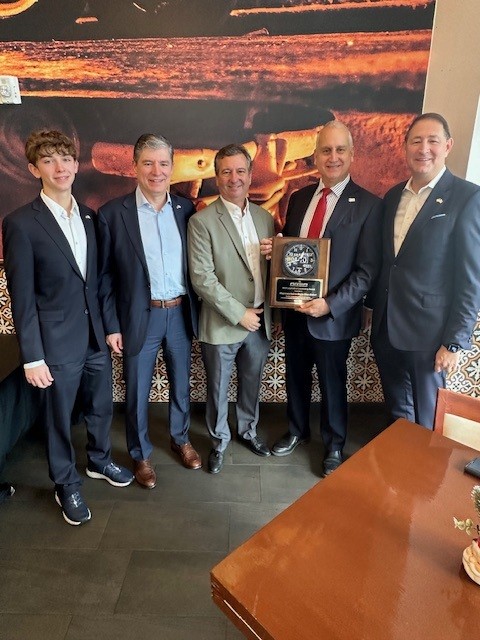
Rep. Mario Diaz-Balart (holding plaque) poses after receiving ARSA’s Legislative Leadership Award with (left to right) Daniel Mendelson, Eric A. Mendelson, HEICO Co-Chairman & Co-CEO, Alex de Gunten, HEICO Business Development Officer, and Victor H. Mendelson, HEICO Co-Chairman & Co-CEO.
Regulatory Updates
Tariffs Today
The October “Legal Brief” chronicled current tariffs impacting aerospace businesses. Resources found can continue to assist ARSA:
- The law firm ReedSmith has set up a “Trump 2.0 Tariff Tracker.” The site provides information about country- and product-specific tariffs, reciprocal tariff exemptions, etc. and updates about litigation activity. The firm also maintains a “Trade Compliance Resource Hub” with additional analysis.
- S. Customs and Border Protection (CBP) website provides an overview of the import and export processes and related duties, taxes, and fees, as does this CBP video.
- Customs brokers licensed by CBP to help importers comply with tariffs and other import requirements. The CBP provides a list of licensed brokers that can be sorted by location, but unfortunately not specialty (g., “aviation”). Customs brokers may lack relevant experience, so be sure to ask about their past work on aviation imports.
- In certain circumstances, goods manufactured in, or exported from, the United States can be reimported duty free. More information about returning goods is available on CBP’s website.
- Another option for repair stations seeking to import and avoid tariffs on aviation articles requiring maintenance is “Temporary Import Under Bond” (TIB). TIB can be used to import certain without payment of duty if the importer intends to export or destroy the goods within three years from the date of importation. More information is on the CBP website.
FAA Updates Public “Services & Contacts” for Office of Safety Standards
The FAA Office of Safety Standards has updated its “Services and Contacts” directory, which is available as a downloadable PDF. The document includes names, contact emails, and office numbers for management and support personnel in each AFS office. It also provides a bulleted list describing each office’s areas of responsibility (e.g., it can be used to determine where to call/email before sending the message) and includes a link to the overall stakeholder feedback form.
The tool is particularly important since the FAA took down its searchable employee directory years ago, meaning this document is now the primary public tool for finding AFS personnel. Association members are encouraged to bookmark the page hosting the document. The FAA updates it regularly, so the industry should routinely return to the source for new versions.
To access the page, click here.
To download a copy of the directory as made available on Oct. 1, click here.
Training & Career Development
Make ARSA Training Work
ARSA’s online training program represents its most-valuable benefit to the aviation industry: knowledge gained through training and experience. The association’s team has turned its decades of work on behalf of aviation maintenance into more than 80 hours of on-demand content.
While sessions are available for registration at any time – ARSA member discounts available – companies can also incorporate the association’s training into their regular programs:
(1) Subscription. Make up-front, bulk purchases of training hours. The details of each subscription can be customized, including focus on specific subject areas (e.g., human factors) or options for specially-priced session access after the initial hours have been used.
(2) “Championing” a session. Guarantee a certain number of attendees for training in a particular topic that will also be made available for general registration. Variations include open registration for a live session (i.e., company personnel participate at the same time as general registrants) or a company-specific live event for which a recorded version (not including any company-specific information) is made available for on-demand registration.
(3) Tailored training. Contract ARSA’s management firm Obadal, Filler, MacLeod & Klein, P.L.C. to produce or modify training specific to your organization. The team can then re-record it (or offer it as a separate live session) for ARSA’s training program. Tailored programs are priced differently from ARSA’s hourly rate and are administered by OFM&K, which allows for a client engagement and related attorney-client privilege for all discussion.
For more information about ARSA’s training program, review the menus below. If you have questions or would like to learn more about ways to integrate ARSA training into your own program, contact Vice President of Operations Brett Levanto (brett.levanto@arsa.org).
Government employees: Contact ARSA directly for auditing opportunities.
Registration: Registration and payment may be processed directly through the training platform/course catalog (free account creation required).
Technical questions and assistance: Click here for FAQ and technical support from training platform vendor.
Refunds: No refunds are granted for ARSA training sessions. When classes are canceled, registrants can choose from future courses of equal value. If a registrant is unable to attend a live session, their registration allows access to the on-demand, recorded version of the webinar.
IA Approval: A number of ARSA training sessions have been accepted for Inspection Authorization (IA) renewal credit. These sessions are denoted on their registration page with their FAA course acceptance number (in red).
Benefits: Registration for an ARSA-provided training session includes:
- Access to the live class session on the scheduled date (if applicable).
- Unlimited access to the on-demand, recorded version of the webinar to be made available after the live session is complete (or at time of purchase, for on-demand classes).
- A copy of the presentation and all reference material with links to relevant resources and citations.
- A certificate* upon completion of the session as well as any required test material.
OFM&K Training Portal: All of ARSA's training sessions are provided through OFM&K's training portal. As the training provider of choice for ARSA and a trusted resource for the aviation community, the firm's training materials represent a vital tool for entities pursuing regulatory compliance and business success. All of the courses are administered via PotomacLaw.InreachCE.com, which is not part of ARSA's website.
Complying with Part 145 – “Soup to Nuts” (Four Hours) Instructor: Sarah MacLeod Description: Specially recorded with a hand-picked audience for interactive discussion, this session thoroughly reviews 14 CFR part 145, discusses the application of the rule and overviews some practical implications of obtaining and maintaining a repair station certificate. Pricing Note: This is a four-hour session and is $300 for members and $600 for non-members. Click here to register and get access for 90 days.
Sessions Accepted for IA Renewal Credit Eight of ARSA's on-demand training sessions have been accepted by the FAA for Inspection Authorization renewal credit under 14 CFR § 65.93. Each session is currently available for registration and immediate access:Click here to purchase all eight sessions (plus one required prerequisite) at a “bundled” discount – let ARSA take care of your IA renewal requirements this year. Click here to purchase all eight sessions (plus one required prerequisite) at a “bundled” discount.
Aircraft Parts
Audit Activism & Prophylactic Lawyering
Drug & Alcohol Testing
Human Factors
Instructions for Continued Airworthiness
Parts 21, 43, 65, 145 (and others)
Public Aircraft"Going Global" - International Regulatory Law
Grassroots Advocacy
Recordkeeping – "Finishing the Job with Proper Paperwork"
The Fourth Branch of Government (Administrative Agencies and Procedures)
Self Disclosure Programs and Practices
(1) Subscription. Make up-front, bulk purchases of training hours. The details of each subscription can be customized, including focus on specific subject areas (e.g., human factors) or options for specially-priced session access after the initial hours have been used.
(2) “Championing” a session. Guarantee a certain number of attendees for training in a particular topic that will also be made available for general registration. Variations include open registration for a live session (i.e., company personnel participate at the same time as general registrants) or a company-specific live event for which a recorded version (not including any company-specific information) is made available for on-demand registration.
(3) Tailored training. Contract ARSA's management firm Obadal, Filler, MacLeod & Klein, P.L.C. to produce or modify training specific to your organization. The team can then re-record it (or offer it as a separate live session) for ARSA’s training program. Tailored programs are priced differently from ARSA’s hourly rate and are administered by OFM&K, which allows for a client engagement and related attorney-client privilege for all discussion.
For more information about ARSA's training program, review the menus below. If you have questions or would like to learn more about ways to integrate ARSA training into your own program, contact Vice President of Operations Brett Levanto (brett.levanto@arsa.org).The association’s training program is provided through Obadal, Filler, MacLeod & Klein, P.L.C., the firm that manages ARSA. To go directly to OFM&K’s online training portal, visit potomaclaw.inreachce.com. To learn more about the association’s training program and see course availability, visit arsa.org/training.
What training do you need? Contact ARSA to let the association know and help get it developed.
SMS Integration Webinar Series Continues Dec. 16
On Nov. 18, ARSA and the Aircraft Electronics Association presented the second of six planned webinars – a monthly series stretching into March 2026 – explaining effective integration of a safety management system within the operations of an FAA-certificated repair station. These hour-long virtual sessions will help U.S.-based repair stations holding European approval to implement a part 5 compliant SMS programs as required by the special conditions of the bilateral agreement between the United States and European Union. This requirement to “design, implement, and maintain” an SMS should be met by effectively and efficiently integrating SMS into the facility’s existing quality system and daily operations.
After introducing the regulatory requirements associated with SMS implementation for U.S. repair stations in the the first session, ARSA and AEA introduced their updated gap analysis tool and began walking through key elements of 14 CFR part 5, subparts A and B. The session materials and recording from completed webinars are available within the SMS tools managed by AEA and available for discounted access to ARSA members. Interested participants should mark their calendars for the remaining sessions, each beginning at 1:00 p.m. Eastern Time:
- October 29, 2025 – SMS Integration Overview – COMPLETE
- November 18, 2025 – SMS Compliance Elements: Part 5 Subparts A & B – COMPLETE
- December 16, 2025 – SMS Compliance Elements: Part 5 Subparts C & D
- January 20, 2026
- February 10, 2026
- March 10, 2026
Session 3
Title: SMS Compliance Elements: Part 5 Subparts C & D
Date: Tuesday, December 16, 2025
Time: 1:00pm – 2:00pm EST
Registration: Click here.
For more information about webinar logistics, contact Ric Peri, AEA vice president of government and industry affairs, at ricp@aea.net.
Interested ARSA members should learn about access to SMS tools available through the association’s partnership with AEA.
Seeing Aerospace Maintenance
ARSA has begun collecting media celebrating the talent and commitment to safety of the aerospace maintenance community. Have an example you’d like celebrated? Contact the the association.
Click here to see the page and learn about the industry’s information portal at avmro.arsa.org.
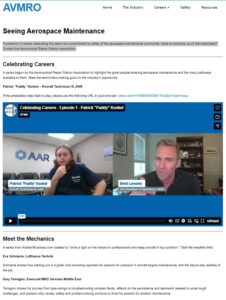
Click the image to go to the page.
Conference Throwback – Best Practices in Rulemaking
To help members consider their attendance plans for the 2026 event (March 17-20), this session demonstrates how Conference content informs participants about regulatory and business updates while providing tools for industry action. This hour long discussion between ARSA team members and former FAA executives explored how the maintenance community can better instruct the government on developing effective aviation safety rules. The discussion is provided in its entirety for the benefit of members.
Thursday, March 20, 2025 | 2:00 p.m. | Best Approaches to Rulemaking 
Industry can push the government to follow its statutory requirements for transparency and public engagement. Learn how to support this effort through the experience of ARSA with former FAA personnel.
Tony Fazio, President, Fazio Group International
Lirio Liu, Executive Director, Willow Aviation Advisors
Sarah MacLeod, Executive Director, ARSA
Moderator: Brett Levanto, Vice President of Operations, ARSA
Regulatory Compliance Training
Test your knowledge of 14 CFR §§ 21.47, transferability of a type certificate.
Click here to download the training sheet.

Membership
International Reach
ARSA has been keeping the international aerospace community up to date on its work to limit the damage caused by the FAA’s new drug & alcohol testing requirements. Some repair stations located outside the United States discovered they would be subject to United States drug and alcohol testing regimes (beginning in 2027) after an association alert sent to repair station contacts.
For members and non-members alike, that awareness provides useful time to prepare for very compliance actions…and to follow along as ARSA continues to request simpler solutions.
Help spread the word: Send updates regarding ARSA petitions and tools to colleagues, suppliers, and other contacts. Let them know there’s an association working on their behalf and tell them how to help.
Step (1), join ARSA.
Step (2), comment on its open petition for reconciliation to simplify D&A testing rules.
Step (3), tell a friend or colleague to do the same.
Welcome & Welcome Back – New & Renewing Members
ARSA’s members give the association life – its work on behalf of the maintenance community depends on the commitment of these organizations. Here’s to the companies that joined or renewed in November:
New Members
Heritage Turbines, Inc., R01
MeasureTech, Inc., R01
Rapid Imaging Solutions, LLC, R01
Rover Aerospace, Inc. dba Altima Technologies, R01
Renewed Members
Airborne Maintenance & Engineering Services, Inc.-Wilmington, R06, 2010
A.O.G Aircraft Service Inc., R01, 2018
Aero Products Component Services, Inc., R03, 2019
Austin Aerotech Repair Services, Inc., R01, 2012
Gulf Aerospace, Inc., R02, 2005
Gulfstream Aerospace Corporation, Enterprise, 1999
Gyros Unlimited dba North Bay Aviation, R03, 2024
Liebherr Aerospace Saline, Inc., R05, 2006
Peter Stonefield, Affil, 2011
Quality Aircraft Accessories, Inc., R01, 2021
Rapco Fleet Support, Inc., R01, 2008
Repairtech International, Inc., R03, 1992
STE North America, Enterprise, 2006
A Member Asked…Refurbishment?
Q: Please help us with the definition of “refurbishment.”
We just received a temporary revision of a CMM that defines “refurbishment” including a list of items to be replaced regardless of their condition. How does this term compare to “overhaul,” which is not defined or used in the manual? Can we issue a maintenance release stating “refurbishment”?
A: An issue that plagues the aviation industry is the improper use of words or use of words and terms that are not defined by various civil aviation authorities. Just because an “OEM” uses a word or term to describe its recommendations does not mean it has regulatory meaning.
Starting with the regulations; § 43.2(a) requires the article to be disassembled, cleaned, inspected, parts repaired or replaced as necessary, and reassembled in accordance “methods, techniques, and practices acceptable to the” FAA. Which, under section 43.13, means there can be use of “other methods, techniques, and practices” than those developed by the manufacturer, provided the “test” is passed in accordance with the production approval (PC, TSOA, or PMA) holder’s current standards and technical data or another test approved by the FAA (or a designee).
The FAA has issued multiple legal opinions on the use of the term “overhaul” which can be found in ARSA training sessions or by searching the ARSA website for the term “overhaul” or in the Dynamic Regulatory System (DRS) under Office of the Chief Counsel (AGC) Legal Interpretations – CFR Part Reference “Part 43”, search term “overhaul.”
If there are “other methods, techniques, and practices” for determining whether an internal component of the article undergoing a “refurbishment” needs to be repaired or replaced, and the “current” data from the manufacturer no longer provides the information, but an earlier version of the manual does, unless there is an airworthiness directive demanding the replacement, the alternative “method, technique, and practice” of inspection to determine condition can be used under 14 CFR, even in an “overhaul” situation.
Remember, an approval for return to service is for the work performed. The term “overhaul” was meant to depict the “greatest extent of work possible” on a given item to return it to at least its original condition. If replacement has been determined to be a more reliable method of ensuring the longest time on wing, it may behoove the company to heed the “recommendation” from the manufacturer. However, if items now are to be replaced regardless of condition, the recommendation may have other motives behind it, like making more money, not restoring reliability.
Have questions about aviation regulatory compliance, legislative policy, or ARSA resources? Ask ARSA first!
Resources
ARSA strives to provide resources to educate the general public about the work of the association’s member organizations; should you need to provide a quick reference or introductory overview to the global MRO industry, please utilize AVMRO.ARSA.org.
Careers in Aviation Maintenance
How do you share the industry’s story with the people who could be its future? Teach them about the great work done every day to keep the world in flight. (Even if we can’t recruit somebody, we sure can make them thankful for our work.)
ARSA Member Benefits
From access to industry expertise to growing your own through education and training, ensure your company gets the most out of its investment in ARSA.
U.S. Legislative Action Center
ARSA requests its members’ assistance to keep FAA reauthorization front and center on the congressional agenda and ensure our workforce priorities are included. Please use ARSA’s grassroots action center (sponsored by Aircraft Electric Motors) to send a quick note to your elected representatives in support of our efforts.
Industry Meetings & Events
| Event/Meeting | Dates | Location |
| Aerial Works Safety Conference | 12/7-9/2025 | Boise, Idaho |
| MRO Latin America | 1/14-15/2026 | Santiago, Chile |
| Singapore Air Show | 2/3-8/2026 | Singapore |
| MRO Middle East | 2/4-5/2026 | Dubai |
| AeroEngines Americas | 2/10-11/2026 | Tampa, Florida |
| VERTICON | 3/9-12/2026 | Atlanta, Georgia |
| ARSA Annual Conference | 3/17-20/2026 | Arlington, Virginia |
| AEA Convention | 3/23-26/2026 | Dallas, Texas |
| ATEC Annual Conference | 3/29-4/3/2026 | Portland, Oregon |
the hotline is the monthly publication of the Aeronautical Repair Station Association (ARSA), the not-for-profit international trade association for certificated repair stations. It is for the exclusive use of ARSA members and federal employees on the ARSA mailing list. For a membership application, please call 703.739.9543 or visit arsa.org/membership/join. For information about previous editions, submit a request through arsa.org/contact. This material is provided for educational and informational purposes only. It does not constitute legal, consulting, tax or any other type of professional advice. Law, regulations, guidance and government policies change frequently. While ARSA updates this material, we do not guarantee its accuracy. In addition, the application of this material to a particular situation is always dependent on the facts and circumstances involved. The use of this material is therefore at your own risk. All content in the hotline, except where indicated otherwise, is the property of ARSA. This content may not be reproduced, distributed or displayed, nor may derivatives or presentations be created from it in whole or in part, in any manner without the prior written consent of ARSA. ARSA grants its members a non-exclusive license to reproduce the content of the hotline. Employees of member organizations are the only parties authorized to receive a duplicate of the hotline. ARSA reserves all remaining rights and will use any means necessary to protect its intellectual property.
© 2025 Aeronautical Repair Station Association