


2026 – Edition 7 – August 7
Table of Contents
Note: The order of material varies in hotline emails, but is always presented the same on this landing page. Readers scrolling through content on or printing this page will find it organized consistent with the table of contents.
President’s Desk
Show ‘Em What You’ve Got
Following ARSA’s advice and industry pragmatism, Chromalloy regularly hosts FAA personnel to tour facilities, watch operations, learn how certification projects are initiated, and to become generally familiar with how industry shows compliance.
It is wise to get face time with regulators on “good days” rather than only calling (or getting called) when times are bad. More importantly, companies are the government’s best source of information on compliance elements, as well as new tools, techniques, and technologies.
Emerging from the pandemic was painful. Business recovered as passengers returned to travel, but considerable talent and experience was lost. In particular, the pain of replacing experienced individuals equates to relative inexperience in the workforce. Inexperience results in delays, poor communications, and repetitive actions as new or different people are assigned to a project. These issues can be mitigated by the industry literally opening doors to education and experience.
Each onsite visit from the agency needs to highlight the compliance and technical system utilized in the operation. At one location, Chromalloy covers showing compliance including testing and data generation, engineering and design tools, and how advanced tools help meet long established standards.
Certificate and approval holders are technical experts. We can advance aerospace and the government’s oversight by demonstrating a constant supply of real-world compliance experience and knowledge. By hosting the FAA serves all interests rather than letting ignorance and protectionism fester and grow.
ARSA provides information on regulatory compliance knowledge. The ongoing series of workshops – turned into on-demand training sessions – with Flight Standards and Aircraft Certification personnel are open to all. The purpose is to give the regulators a baseline in the aerospace industry and the laws, rules, and realities of the American executive branch’s relationship to the public.
Start showing the FAA what you can do. Send a video to the association (to use in the AVMRO industry portal), host a visit, show off your technology. Show ‘em what you’ve got.
 |
John Riggs 2025 ARSA president | Director of Airworthiness, Chromalloy |
ARSA Remembers
Dave Harrington

Photo courtesy the Harrington family.
Colonel David R. “Dave” Harrington , a decorated Air Force pilot, Distinguished Flying Cross recipient, former FAA Flight Standards Service director, husband, father, Pop Pop, and friend, died peacefully on July 1, surrounded by his family. He was 85.
Born in Boston on Nov. 6, 1940, Dave attended the University of Massachusetts on a football scholarship and was named a Yankee Conference All-Star before graduating in 1963. Later that year, he was commissioned as a second lieutenant in the United States Air Force.
During the Vietnam War, Dave flew C-130 transport aircraft throughout Southeast Asia. Over the course of his military career, he served as commander of the 756th Military Airlift Squadron and vice commander of the 459th Military Airlift Wing. He received the Distinguished Flying Cross for heroism and extraordinary achievement, the Meritorious Service Medal, the Humanitarian Service Award, multiple Air Medals, and numerous other military decorations. He retired from the Air Force Reserve as a Colonel after nearly 30 years of service.
In 1974, Dave joined the FAA, where he spent the next 23 years. He rose to director of the Flight Standards Service before concluding his career as an aviation safety consultant with Airbus North America.
Outside of aviation, Dave loved sports and played golf until just a few months before his death. He had five holes-in-one over the years and enjoyed giving his friends – including ARSA Managing Director & General Counsel Marshall Filler – a hard time on the course. He always seemed to have one more one-liner. He was a lifelong Red Sox and Commanders fan. He loved Seinfeld, kielbasa, fish and chips, bluegrass, John Denver, and spending time with family and friends, especially at the family’s beach house in Duck, North Carolina.
“Dave was among the most positive, nicest people I’ve known and he taught me a lot about flight operations when I was a wet behind the ears attorney in the Accident Litigation branch of [the Office of the FAA’s Chief Counsel],” Filler said about Harrington. “He was a wonderful human by any measure.”
Dave was incredibly proud of his children, Tracey and Michael. There was no title he loved more than Pop Pop. His grandchildren were the joy of his life, and nothing made him happier than watching them grow up and hearing about everything they did.
He is reunited with his wife of 42 years, Nancy Allison Harrington who passed away in 2018.
Dave is survived by his daughter, Tracey Harrington McCoy, and her husband, Nick McCoy, of Fairfax, Virginia; his son, Michael Harrington, and his wife, Paula Hurtado, of Fredericksburg, Virginia; and his four grandchildren, Kai, Ryan, Reese, and Andrew.
A Celebration of Life will take place from 2-5pm on July 27 at Army Navy Country Club, Fairfax. All who loved Dave are welcome. Interment at Arlington National Cemetery will take place at a later date.
To see Davy’s obituary and share memories with the family, click here.
To see the colleagues and friends ARSA continues to remember, visit arsa.org/arsa-remembers.
Neil Eisner

Neil Eisner. Photo courtesy the Eisner family.
Neil Eisner of Falls Church, VA who previously served with the FAA and DOT in several senior legal and policy positions, died on July 16 following a long illness. He was 83.
“Neil was one of the most hard-working and conscientious government employees we at ARSA had the pleasure of knowing and working with on a regular basis,” said Managing Director & General Counsel Marshall Filler about his first boss at the FAA; The two met when Eisner was manager of the accident litigation branch of the chief counsel’s office and Filler was a newly hired agency attorney. “I learned as much from Neil in those formative years of my professional career as I did from anyone. He was always patient and encouraging.”
Eisner retired in 2013 as the assistant general counsel for regulation and enforcement at the U.S. Department of Transportation. He played a major role in the creation of the first-of-its-kind internet-accessible public docket, as well as an innovative, intranet-based rulemaking management system. He was an adjunct professor at American University’s Washington College of Law, publishing multiple articles and presenting publicly on a variety of subjects.
In 2014, ARSA presented Eisner with the Leo Weston Award for Excellence in Government Service, given regularly to individuals who made a lasting impact in promoting the principles of “good government.” The tangible portion of the Weston Award is customized to the recipient: ARSA presented Eisner with a limited edition, framed commemoration of Mickey Mantle’s 18 World Series Home Runs, a record that stands to this day. Eisner and Filler, who delivered the award, were avid Yankee fans; each grew up in the New York City area when the team won numerous American League pennants and World Series titles.
“Neil will be deeply missed by his family and friends but his contributions to the principles of good government will live on,” Filler said.
A celebration of life will be announced at a later date. To read Neil’s obituary, click here.
ARSA Honors Neil R. Eisner with the Leo Weston Award
March 25, 2014
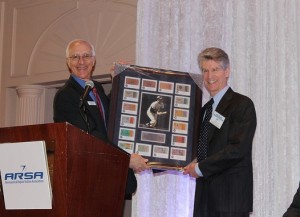
On Thursday, March 20th, 2014, ARSA Managing Director and General Council Marshall S. Filler presented the Leo Weston Award for Excellence in Government Service to Neil Eisner. The Weston Award, which was created in 2006, is given regularly by ARSA to individuals who have made a lasting impact on the practice of good government.
Mr. Eisner retired in 2013 as the Assistant General Counsel for Regulation and Enforcement at the U.S. Department of Transportation. He played a major role in the creation of the first-of-its-kind the internet-accessible public docket as well as an innovative, intranet-based rule making management system. He is now an adjunct professor at American University’s Washington College of Law, and he has published multiple articles and presented numerous speeches in different forums on a variety of subjects.
Upon presenting the award to Mr. Eisner, Filler explained: “We present this award to Neil not [just] because he is a good friend, but because he is a staunch advocate of good government.”
To see the colleagues and friends ARSA continues to remember, visit arsa.org/arsa-remembers.
ARSA Works
What ARSA Has Done Lately – 2nd Quarter 2026
Each quarter the board of directors receives reports on the association’s activities and fiscal health. In turn, the membership steps into the board member’s shoes with this overview of the second quarter.
Fiscal Health
The association hit the year’s halfway mark approaching 60 percent of its budgeted revenue for 2026. Effective membership retention and boosted training income (new sessions) drove success.
Membership
New and recovered members far outpaced cancellations in the quarter with year-to-date retention at 93 percent.
Regulatory Advocacy
- Responded to FAA feedback request on pre-rulemaking analysis by agency ahead of establishing options for direct recognition of foreign maintenance organizations.
- Released tool for demonstrating compliance with IA renewal training option provided by § 65.93(a)(4).
- Supported working group updating Airman Certification Standards.
- Stimulated testing and international analysis associated with Foreign Repair Station D&A Compliance Toolkit.
- Reported UK alignment of renewal process with MAG language.
- Participated in FAA ICA ARC, including leading development of ARC report Owner/Operation/MRO position paper.
- Coordinated with enterprise members and/or authorities regarding ARSA foreign repair station D&A toolkit use and potential country-wide recognition waivers for Germany, Netherlands, UK, Singapore, Japan, Thailand, and Mexico.
- Participated in 2026 FAA/EASA International Safety Conference, including moderating panel on the use of emerging technologies in aviation maintenance.
- Engaged with FAA in support of reciprocal acceptance rulemaking petition.
- Supported DOD implementation of FY 2026 NDAA directive to harmonize PMA parts requirements between service branches.
Legislative Action and Lobbying
- Successfully included right-to-repair legislation in House and Senate committee versions of FY 2027 National Defense Authorization Act (NDAA).
- Removed restrictions on use of Sec. 625 workforce program monies from FY 2027 Transportation, Housing, and Urban Development appropriations bill ($40 million in total funding and no restrictions in House bill; Senate bill pending).
- Built awareness of designee class action lawsuit against FAA in anticipation of potential legislative action.
Communication and Surveys
ARSA-placed Industry Editorials and Content
| AMT Magazine | Making the Case: Why It’s Key to Defend Part 65 Repairmen as Perry Mason Would April 2026 | Brett Levanto |
| Defending the Repairman in the Court of Public Opinion May 2026 | Brett Levanto |
|
| FAA Must Follow Its Own Rules June 2026 | Christian Klein |
|
| Aviation Maintenance Magazine | Peering Over Cylinders of Excellence Q2 2026 | Brett Levanto |
| Aviation Week | Opinion: Preparing for the FAA’s Global Substance Testing Requirements May/June 2026 | Christian Klein |
| DOM Magazine | Finding Lessons April 2026 | Brett Levanto |
| Moving Sad Scraps of Paper May 2026 | Brett Levanto |
|
| General Collaboration June 2026 | Brett Levanto |
ARSA in the News – Selected Industry Coverage
How Trump’s Immigration Crackdown Is Affecting Aviation Worker Shortages
Simply Flying | April 22, 2026
To be fair to the Trump Administration, US aviation’s staffing problem predates the President’s second term. Recent pipeline analysis from the Aeronautical Repair Station Association (ARSA) said that heightened demand from commercial air transport alone created a 10% shortage in certificated mechanics in 2025, or some 16,000 personnel according to Bureau of Labor Statistics (BLS) data. It predicted that even by 2035, the gap would still be more than 10,000 certificated mechanics, indicating a structural shortfall, not a temporary blip.
Workforce Shortage Stunting Industry Growth, Costing Billions [Series]
Leeham News and Analysis | May 5, 2026
We do not know the cost of workforce shortages for airlines, aviation and aerospace manufacturers, airports, aviation maintenance, or operations. Only the Aeronautical Repair Station Association report puts a number – $27bn – on that cost of not having the right workforce, and that is still not the entire picture.
Right to Repair Saves Money, Strengthens National Security
Project on Government Oversight | June 3, 2026
High-ranking officials from each of the different services told Congress they support right-to-repair reforms as a way to ensure that taxpayer savings, service member safety, and military readiness are prioritized in all new defense contracts.
Surveys (Still open for responses)
- SMS Lessons
- How Consistent is the FAA?
- Surveying to Update Knowledge Test (FAA Contractor)
Operations
Events
Began preparation of 2026 Fall Leadership Roundtables.
Workforce
- Sponsored and supported Aerospace Maintenance Council Competition hosted during MRO Americas in Orlando, Florida.
- Presented at MRO Americas career event with students from Orlando-area high schools as well as Central Florida University.
- Resubmitted application for FAA Technical Workforce Grant Program, led by partners at Choose Aerospace.
Training
- Continued co-presenting monthly webinar series with the Aircraft Electronics Association on Safety Management System Implementation. Made most recent sessions available on-demand through ARSA training program.
- Monthly FAA Workshop series for government (AIR and AFS) and industry audiences. Sessions available on demand after presentation through ARSA training program.
- Rolled out new live sessions for general registration, beginning with update to complete series on “Complying with Part 145.”
Sucking Eggs and Repairing TSOA Articles
Teaching (your) grandmother to suck eggs is an English saying that refers to a person giving advice to another person in a subject with which the other person should already be familiar.
A July 30 ARSA letter provided regulatory confirmation to the FAA that nothing in the aviation safety rules prohibits independent repairs on articles designed and produced under technical standard order authorizations (TSOA).
The letter catalogued statements made by agency personnel to association member representatives inaccurately claiming limitations on or prohibitions of repairs on such items. For each statement, the letter signed by Executive Director Sarah MacLeod cited parts 1 or 43 to demonstrate definitions and authorization’s confirming the privileges of maintenance providers.
“Many of these roadblocks are based on lack of knowledge and misconceptions,” the letter said about the referenced statements. To remove those “roadblocks,” ARSA repeatedly requested the government read the rules:
(1) § 1.1 defines “maintenance.”
(2) §§ 43.1 and 43.3 grant repair stations the authority to perform maintenance.
(3) § 43.13 allows maintenance actions returning the article to at least its original or properly altered condition.
(4) Determinations on eligibility for installation (based on the definition of “airworthiness” in part 3) are made by persons authorized by part 43.
Reviewing the plain language of these citations confirms the authority of maintenance providers repairing TSOA articles. Focusing on this language prevents confusion caused by misreading the implications of the design and production rules in part 21.
“For future reference, the regulations for maintaining items that have been released from a production approval holder’s quality system are contained in part 43,” the letter said. “The FAA has other rules associated with operating aircraft that individuals in Aircraft Certification may read for personal understanding.”
As ARSA says in its training sessions, reading is required for survival in aerospace.
To read the complete letter, click here.
Push Congress to Invest in Skills Training
ARSA members with U.S. facilities are encouraged to support a Business Leaders United letter to support a letter from employers with U.S. facilities urging congressional leaders to invest in skills training and workforce development.
Dear Speaker Johnson, Leader Jeffries, Leader Thune, and Leader Schumer:
Thank you for your leadership as Congress evaluates funding for federal workforce programs in the 2027 fiscal year. The undersigned businesses and business associations respectfully urge you to maintain and strengthen investments in skills training and workforce development. These programs are a cornerstone of economic growth: they equip workers to move into in‑demand roles, progress in their careers, and adapt to rapid technological shifts—while ensuring employers have access to the talent they need to succeed
In a rapidly changing global economy—and amid accelerating technological advances driven by artificial intelligence—businesses need a workforce with access to high‑quality, affordable, employer‑informed skills training. Employers are already navigating significant workforce pressures. Impending retirements, cross‑industry competition for talent, and inadequate access to worker supports such as childcare and transportation will only intensify demand for skilled workers. These dynamics are particularly acute for small and mid-sized businesses, which often lack the resources to tackle these challenges on their own.1 Yet despite this growing need, the United States has chronically underinvested in its workforce systems and now lags far behind peer nations, limiting the ability of businesses to grow and compete. To meet both immediate and long‑term needs, Congress must support robust investments in skills.
As you work together to finalize spending levels for the 2027 fiscal year, we urge you to pass legislation that:
- Maintains or increases funding for federal workforce programs that serve adults and young people, including work-based learning and upskilling for current workers. These programs deliver employer‑aligned training and education, and cutting current investments would weaken the talent pipeline businesses depend on to expand, innovate, and succeed.
- Provides dedicated funding for industry and sector partnerships. These partnerships give employers a direct role in shaping training and ensure workers receive the skills and services needed to be job‑ready.
- Maintains the current maximum Pell Grant award for workers and students and closes the Pell funding gap. The recent expansion of Pell to shorter‑term, employer‑aligned training makes it an essential tool for building a skilled workforce. Preserving this investment ensures businesses can access the talent they need to meet demand and drive innovation.
U.S. businesses are committed to working with Congress to drive economic growth and ensure workers can access quality jobs. Federal workforce programs are central to that effort. The undersigned businesses and business associations urge you to secure and strengthen funding for these critical programs in the 2027 fiscal year, without reducing current investment levels.
To sign on to the letter, click here or email Jeran Culina, BLU manager. The deadline to join is Sept. 11, 2026.
Convincing FAA of its D&A Authority
As the FAA reported at the 2026 FAA/EASA International Safety Conference in June, the agency’s Drug Abatement Division continues its work on implementation guidance for new drug and alcohol testing requirements to be imposed on certain foreign repair stations at the end of 2027. In July, ARSA provided feedback on the government’s internal draft echoing key themes from its public discourse:
(1) The FAA has the authority to issue waivers from testing requirements imposed by 14 CFR part 120. U.S. regulators can find programs (individually or within an entire foreign jurisdiction) to be equivalent in outcome to the American rules, even without a specific application for such a waiver.
(2) Bilateral relationships should consider testing requirements. Waivers can be included directly into the implementation guidance associated with bilateral aviation safety agreements, allowing the government to protect the equivalent safety outcomes of the international relationship without imposing unnecessary administrative cost.
(3) Streamlined applications should be encouraged. International maintenance organizations with multiple locations, including those overlapping more than one jurisdiction, should be able to seek a waiver for any or all of its facilities under a single application.
(4) Applications should be published for public awareness. The industry can better coordinate when aware of what requests have been submitted before the FAA has responded to the application.
While ARSA and the agency work through specific commentary on draft guidance language, the industry can support international analysis by utilizing the association’s Foreign Repair Station D&A Testing Toolkit. ARSA calls for its foreign members (except those located in Canada) to participate by following these steps:
(1) Gather an internal D&A compliance team that includes HR, legal, quality, and executive representation.
(2) Request the D&A Compliance Toolkit from arsa.org/publications.
(3) Use the D&A Compliance Toolkit and provide feedback to the association.
For background on the issue and ARSA’s advocacy and compliance efforts, visit arsa.org/drugandalcohol and arsa.org/regulatory/faa/operations/drug-and-alcohol-testing.
Final Documents/Your Two Cents
This list includes Federal Register publications, such as final rules, Advisory Circulars and policy statements, as well as proposed rules and policies of interest to ARSA members.
Legal Brief
Editor’s note: This material is provided as a service to association members for educational and informational purposes only. It does not constitute legal or professional advice and is not privileged or confidential.
It Ain’t Just Regulations
By Christian Klein, Executive Vice President
Aviation is among the most heavily regulated industries on the planet. Regulatory knowledge is essential to success. Control doesn’t stop with the regulations; U.S. aviation laws create additional obligations and complexity.
Supplemental type certificates (STCs) are just one of the many areas where the law applies (we’ll be talking about others in next month’s column).
The FAA’s STC regulations were not developed in a vacuum; they derive from the broad statutory authority Congress granted the FAA to promulgate regulations (49 USC § 106(f)(4)) and on 49 USC § 44704, which addresses type, production, airworthiness, and design and production certificates.
49 USC § 44704(b)(1) empowers the Administrator to issue “…a supplemental type certificate for a change to an aircraft, aircraft engine, propeller, or appliance” (Type certificates (TCs) are addressed in § (a)(1)). Sec. (b)(2) states that the STC consists of “the change to the aircraft, aircraft engine, propeller, or appliance with respect to the previously issued type certificate for the aircraft, aircraft engine, propeller, or appliance.”
Based on that statutory framework, the FAA promulgated 14 CFR part 21, subpart E, which prescribes “procedural requirements” for the issue of STCs. The subpart explains when an STC is required (§ 21.113), applicable airworthiness standards (§ 21.115), when an applicant is entitled to an STC and its contents (§ 21.117) and associated privileges (§ 21.119).
But Congress didn’t just direct the FAA to issue STCs; it also established STC holder intellectual property rights. 49 USC § 44704(b)(3) prohibits a person other than the STC holder from using the STC without the holder’s written permission.
The change in the law led the FAA to promulgate § 21.120, which provides that an STC holder, must provide authorized persons with written permission to use the STC. The same ban is in §. 91.403(d) which prohibits altering an aircraft based on an STC unless the owner or operator of the aircraft is the STC holder or has its written permission.
It’s important to note the difference between those statutory and regulatory intellectual property protections. The statute, which is broader, prohibits using an STC in any way without the holder’s written permission, while the regulations focus on using the STC to alter an aircraft.
That nuance creates challenges and potential legal jeopardy for parts producers. Title 14 CFR § 21.9(b) prohibits the producer of a replacement or modification article from representing that the part is eligible for installation on a TC’d product unless the article is produced under a type certificate or FAA production approval. In other words, while an STC holder may have given you the necessary written permission to install an STC (e.g., a single-installation data license), it doesn’t mean you have the rights to “use” the STC under § 21.9(b) to produce parts for sale and installation.
The bottom line is that purchasing an STC license has both statutory and regulatory implications. The buyer must ensure it obtains all the rights it needs to support the product after the STC is installed, including permission to manufacture parts under § 21.9(b). Meanwhile, the seller must understand the rights it has, the rights its licensing, and the buyer’s intended use to ensure alignment.
Layman Lawyer
Editor’s note: This material is provided as a service to association members for educational and informational purposes only. It does not constitute legal or professional advice and is not privileged or confidential.
Keeping Focus
By Brett Levanto, Vice President of Operations
Regulatory compliance requires focus. Getting lost in nuances happens far too often and is sure to occur when certificate or approval holders (or the government) forget to read the applicability of a specific rule.
This edition’s “real” Legal Brief and a July 30 letter from the executive director to the FAA provide useful opportunities to practice this focus. Design and/or production authority under technical standard order authorizations (TSOA) and supplemental type certificates (STC) exist under part 21, but authority for installation or repair of aerospace articles is granted under part 43.
The rule applies to “maintenance, preventive maintenance, rebuilding, and alteration” of aircraft having a U.S. airworthiness certificate and the appliances and component parts of those aircraft. Sections 43.3 and 43.7 grant authorization to certain persons to perform maintenance, preventive maintenance, and alteration and approve the related work for return to service. Those persons, including mechanics, repairmen, repair stations, manufacturers, and air carriers.
The “permission” requirement in § 21.120 establishes a paperwork constraint, met by documentation to “allow a person to use” the STC. Still, the responsibility for performing and approving work for return to service rests on the maintenance provider. Whether that work is an alteration related to STC installation or a repair of an article produced under any authority found in part 21, e.g., TSOA.
While performing the work, the maintenance provider may obtain parts produced by the STC holder, fabricate them (as allowed by § 21.9(a)(6)), or utilize those produced by the owner/operator (as allowed by § 21.9(a)(5)). Those opportunities in part 21 remain subject to the materials standards in § 43.13(b) and the basic definition of “airworthy” in part 3.
However compliance is described – ARSA’s leaders are fond of a “slalom course” requiring you start on the right mountain. The rules demand attention to applicability and overlap. Getting through the many approvals, acceptances, and authorities described in the rules demands keeping focused on which applies where, when, and to whom.
ARSA on the Hill
What’s at Stake in the Midterms?
By Christian Klein, Executive Vice President
During the congressional August recess representatives and senators hurry home to campaign for November’s mid-term congressional elections. There’s a lot at stake.
Republicans are defending slim majorities in both the House and Senate and, with President Trump’s historically low public approval, Democrats smell blood in the water.
The party in the White House has lost seats in all but two mid-term elections in the last half century. During President Trump’s first term, the Republican party lost a record 40 House seats in 2018. However, the past doesn’t necessarily predict the future: Republicans picked up two Senate seats during that same election.
In the 100-member Senate, the numbers favor the Democrats in 2026. A net gain of four seats will win control. Of the 35 Senate seats up for grabs, the GOP currently controls 22 and the Democrats 13, forcing Republicans to play defense in almost twice as many races.
A Democratic Senate takeover is far from certain: To net four, the party must defend at-risk seats in Georgia and Michigan and pull off wins in the competitive Republican-held seats in Maine, North Carolina, Alaska, Iowa, Ohio, or Texas.
In the 435-member House, Democrats need a net gain of three seats to take back control. That may not be as easy as it sounds: Democrats are defending more highly competitive seats than Republicans (25 to 21) and 21 Democrats are running in districts President Trump won in 2024.
Adding to the uncertainty are new congressional maps in California and Utah that changed six seats in favor of Democrats and in Florida, Missouri, Tennessee, Ohio, North Carolina, Alabama and Texas to favor 16 additional Republicans.
Recent elections have proved difficult to predict, but aviation safety isn’t a partisan issue. ARSA works to build strong relationships on both sides of the aisle to remain effective. ARSA Political Action Committee (ARSA PAC) contributions are given to candidates with a combination of aviation industry experience or ties, a desire to achieve the safest aviation system by the most efficient means possible, a commitment to effective regulatory oversight based on data, not emotion, and a recognition of the industry’s workforce needs.
ARSA PAC doesn’t just drop checks in the mail and forget about them. The association prefers to have its members deliver ARSA PAC checks to candidates in person to build relationships between candidates and maintenance professionals. If you’d like to host a candidate at your facility and/or deliver an ARSA PAC contribution, please contact ARSA.
Steady Progress for Workforce & DoD Right to Repair
ARSA and its allies are making progress in two key areas: improving access to Department of Defense (DOD) maintenance data and FY 2027 funding for the Sec. 625 aviation workforce grant programs.
Technical Data Rights Access
ARSA is acting to use the FY 2027 National Defense Authorization Act (NDAA) for improved access to technical data for aircraft purchased by DOD. ARSA has been joined by a bipartisan coalition of lawmakers and organizations representing past and present service members. The Pentagon is also on the record as supporting enhanced access.
The House passed its NDAA bill including a “Right to Repair” (R2R) provision (H.R. 8800 sec. 824) on July 22 by a party-line vote. The Senate Armed Services Committee’s version also includes R2R (S. 4784 sec. 804) but is stalled on the Senate floor because of Democrat’s objections to the ballooning defense budget and war with Iran. With the clock ticking down to recess, the Senate’s GOP leadership shifted focus from the NDAA to a short-term continuing resolution to keep the federal government operating past the Sept. 30 end of the fiscal year and the November elections.
The NDAA is one of the few annual “must pass” bills and the fact that R2R is currently in both bills increases the likelihood the issue will be addressed in the final conference report.
Of course, the R2R language is opposed by well-healed defense contractors and lobbying groups (including the Aerospace Industries Association). There’s still a possibility that a hostile amendment could be considered when the full Senate eventually debates the bill or that the R2R provision could be watered down in conference, so remain vigilant.
Maintenance Industry Workforce Development
ARSA conceived and led the coalition that created the Sec. 625 grant aviation workforce grant programs, which were recently expanded to authorize $20 million annually for each program. However, the FY 2026 appropriations law siphoned money from the Sec. 625 program to the detriment of the maintenance workforce. ARSA and its allies are pushing for clean funding in FY 2027.
Unfortunately, the appropriations process is stalled. The House Appropriations Committee reported its transportation bill on June 3. It provides $40 billion for the Sec.625 programs and doesn’t include any apparent spending restrictions (see page 34 of the committee report). However, the bill hasn’t yet received a House vote and with less than two months before FY 2027 begins, the Senate Appropriations Committee has not yet released or marked up its bill.
Frustratingly, the appropriations process has stopped working by “regular order” (the legislative process in which both the House and Senate pass a bill that then goes to conference). Instead, Congress has become reliant on hastily negotiated short-term extensions and omnibus bills to fund federal government operations, a process with much less transparency. We’re expecting that again Congress will roll many individual appropriations bills into a year-end package (possibly including the NDAA) to keep the government open into 2027.
Stay tuned as the legislative process slowly grinds forward.
Finding Your Members of Congress
Senators and congressmen use the summer to meet constituents. ARSA members need to take advantage of this interest to schedule facility visits, attend town halls, meet and greets, or any other excuse to spend time with the person representing your business in Congress.
Building an ongoing relationship with elected officials is a matter of simple effort. The most successful constituents are patient and persistent…and they know how to use a few simple tools.
Who represents you?
Using ARSA’s Legislative Advocacy Tools, find your elected officials. Remember to search your personal and all professional zip codes; there may be multiple officials/offices with an interest in your needs. Get started at arsa.org/congress.
When will they be home?
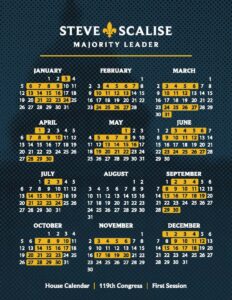
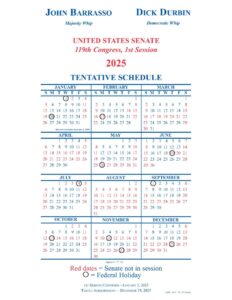
Members of the U.S. Congress try to spend as much time in their states/districts as possible. Both the House and Senate leadership have published session calendars for 2026. By reviewing these calendars, you can determine when your senators and congressman are likely to be “back home” by looking for dates not in session. Review the schedule documents below and find updated information at www.congress.gov/calendars-and-schedules.
House |
Senate |
|
 |
 |
Training & Career Development
Part 145 Series Continues with Two Sessions On Demand
In July and August, ARSA is administering a series of online training sessions combining to walk through every section of 14 CFR part 145, “Repair Stations.” The new series replaces the association’s previous sessions focusing exclusively on the rule, providing new context and analysis of the current regulatory language.
The first two sessions in the series, covering subparts A through C, are now available on-demand for immediate viewing. Two live presentations remain and each will be available on demand once complete; live session registrants get free access to the recording for 90 days and new participants may access it at any time. Interested registrants may select individual hours or purchase a discounted “bundle” to get complete access:
Session 1: Complying with Part 145 – Subparts A & B
Date: Thursday, July 16 @ 11:00 a.m. EDT – COMPLETE
Registration & More Information: Click here for on-demand access.
Session 2: Complying with Part 145 – Subpart C
Date: Wednesday, July 29 @ 11:00 a.m. EDT – COMPLETE
Registration & More Information: Click here for on-demand access.
Session 3: Complying with Part 145 – Subpart D
Date: Wednesday, Aug. 19 @ 11:00 a.m. EDT
Registration & More Information: Click Here
Session 4: Complying with Part 145 – Subpart E
Date: Wednesday, Aug. 26 @ 11:00 a.m. EDT
Registration & More Information: Click Here
To purchase a discounted “bundle of all four sessions (live and on-demand), click here.
Registration for an ARSA-provided training session includes:
- Unlimited access for 90 days to the recording available after the live session is complete.
- A copy of the presentation and all reference material with links to relevant resources and citations.
- A certificate upon completion of the class, as well as any test material.
The association’s training program is provided through Obadal, Filler, MacLeod & Klein, P.L.C., the firm that manages ARSA. To go directly to OFM&K’s online training portal, visit PotomacLaw.inreachce.com. To learn more about the association’s training program and see course availability, visit arsa.org/training.
On Demand SMS Training – Change Management Added
Three Safety Management Systems Training Sessions are now available through ARSA’s training program for registration and immediate on-demand viewing. The trainings were co-administered by ARSA and the Aircraft Electronics Association as part of its ongoing webinar series covering integration of SMS into a repair station’s quality system. Live attendance to the ongoing series is free and the association makes select on-demand resources available as part of its paid online training program, including access to session materials and a completion certificate.
Change Management in a Repair Station
This session describes procedures and tools for managing change within a repair station’s safety management system.
Click here for more information and to register.
Employee Reporting in a Repair Station
This session reviews procedures related to employee reporting under a repair station’s Safety Management System. It uses specific tools to examine communication, documentation, analysis, and action associated with hazards identified by personnel.
Click here for more information and to register.
Root Cause Analysis in a Safety Management System
This session describes procedures and tools for performing root cause analysis within a repair station’s safety management system.
Click here for more information and to register.
Registration for an ARSA-provided training session includes:
- Unlimited access for 90 days to the recording available after the live session is complete.
- A copy of the presentation and all reference material with links to relevant resources and citations.
- A certificate upon completion of the class, as well as any test material.
The association’s training program is provided through Obadal, Filler, MacLeod & Klein, P.L.C., the firm that manages ARSA. To go directly to OFM&K’s online training portal, visit PotomacLaw.inreachce.com. To learn more about the association’s training program and see course availability, visit arsa.org/training.
August SMS Webinar – Your Experience
On Tuesday, Aug. 18, ARSA and the Aircraft Electronics Association (AEA) will co-host the next session in their webinar series explaining integration of a safety management system within the operations of an FAA-certificated repair station. This tenth installment in the ongoing series begun last October will focus on lessons learned by ARSA and AEA members in implementing an SMS.
Contribute to that session (attribution is not required) by sharing your experience at arsa.org/qq-sms.
Session Details
Date & Time: Tuesday, Aug. 18, 2026 @ 1:00 p.m. EDT
Title: Lessons of SMS Integration
Description: This session reviews lessons learned and observations made by repair stations having implemented a safety management system.
Price: Free
Registration: Click Here
The initial series of six sessions (see March 2026 update below) introduced SMS requirements and walked through performing a gap analysis between an existing quality system and the requirements of 14 CFR part 5. ARSA and AEA have planned set of monthly installments continuing to explore elements of SMS compliance:
- May 26, 2026 – Employee Reporting in a Repair Station – COMPLETE
- June 23, 2026 – Root Cause Analysis in a Repair Station SMS – COMPLETE
- July 21, 2026 – Change management – COMPLETE
- August 18, 2026 – Topics from member examples
- September 29, 2026 – AEA SMS Improvements
- October 27, 2026 – What are CAA Audits Finding
- November 17, 2026 – What are CAA Audits Finding
- December 15, 2026 – Discussion with FAA
Questions about webinar administration should be directed to AEA’s Ric Peri (ricp@aea.net). Interested ARSA members should learn about access to SMS tools available through the association’s partnership with AEA:
On Demand Workshop – Administrative Agencies
The recording of ARSA’s special workshop overviewing the construction and authorities of American administrative agencies is now available on demand. The resource was presented to FAA personnel as part of the association’s broader industry education efforts and is a valuable tool for aerospace professionals to understand the basics of the aviation safety rules.
| Workshop Title | Administrative Agencies & Their Powers |
| Workshop Description | This session introduces federal agencies, explains why they are created, and shows how they regulate activities within their jurisdiction. It puts these points in the context of the statutory and regulatory authority driving executive branch action in the United States. |
| Registration | Click here to register and get access for 90 days. Government personnel (with valid .gov or equivalent international email addresses) may access the session for free, contact ARSA for instructions. Individuals who participated in the live session on May 26 get 90 days of access to the recording. |
The session is the second in a planned series that will cover industry and regulatory issues, providing baseline instruction and references for agency personnel. A recording will be available for general registration after each workshop is complete.
The year-long workshop series will also cover:
- Understanding Design, Production, Operations, and Maintenance as a “Cycle of Airworthiness.”
- Resources and actions associated with agency findings.
To see all of the workshops given to the FAA and available for on-demand viewing, visit arsa.org/faa-training.
Regulatory Compliance Training
Test your knowledge of definitions across 14 CFR. The packet contains every compliance training sheet produced by ARSA covering definitions in parts 1, 21, and 145..
Click here to download the packet of training sheets.

Membership
Be an Active Member
What does “active” mean?
It means a member that keeps ARSA up to speed on personnel or company changes to ensure a complete return on investment by using the benefits available to the greatest extent possible.
With each renewal an updated certificate and profile is sent to the designated primary contact asking for updates – ARSA greatly appreciates responses.
An active member does not wait for the yearly reminder to update company information; instead, it uses the ASK ARSA First! system to submit changes as they happen.
Who’s Your Target?
This periodical targets you.
Why? ARSA’s value crosses all “departments” within member companies, no matter the size. Small companies fill multiple roles with one or two individuals.
In bigger enterprises, every department benefits from membership.
Business decisions demand input from all perspectives. ARSA’s contact management efforts (be an “active” member and update your profile!) produces invaluable access for knowledge and, thus, advertisers.
Take advantage of the association’s effort and help partner companies reach their target audience, because this periodical is for them, too.
Learn more and request a placement by visiting the advertising page.
Welcome & Welcome Back – New & Renewing Members
ARSA’s members give the association life – its work on behalf of the maintenance community depends on the commitment of these organizations. Here’s to the companies that joined or renewed in July:
New Members
HOFT Institute, Inc., EDU
First Equity Group, Inc., Assoc
Mountain Wave Aviation, LLC, R01
Propel Aviation Sales & Services, LLC, R03
Aircraft Accessories International LLC, R03
Returning Members
Able Aerospace Services, Inc., R05, 2024
Aero-Craft Hydraulics, Inc., R01, 2025
Aero Instruments & Avionics, Inc., R04, 1991
Air Transport Components, LLC, R03, 2016
Aircraft Ducting Repair, Inc., R03, 2002
Airframe Components by Williams, Inc., R02, 2003
Air Transport Components, LLC, R03, 2016
Allflight Corporation, R03, 2011
Ametek Ameron, LLC dba Ameron Global Product Support, NY-2859, R02, 2004
AMROC, INC., R01, 2024
Astrodyne International, Inc., R01, 2010
Aviation Fabricators, Inc., R03, 2024
Aviation Repair Resources, Inc., R02, 2009
Blankenship, Dwayne, Affil, 2025
Boeing Company, Enterprise, 1196
California Precision Hydraulics, Inc., R01, 2025
F&E Aircraft Maintenance, LLC (FEAM), R06, 2012
General MRO Aerospace, Inc., R03, 2015
Marana Aerospace Solutions, Inc. dba Ascent Aviation Services, R06, 2023
Marvel-Schebler Aircraft Carburetors, LLC, R02, 2011
MT-Propeller Gerd Muehlbauer GmbH, R04, 2025
Myrat Koturov, Affiliate, 2024
NAASCO Northeast Corp., R02, 2002
NFF Avionics Services, Inc. dba NFF Aviation Services, R02, 2010
Ozark Aeroworks, LLC, R02, 2015
Rotorcraft Repair & Manufacturing, LLC, R01, 2019
Summit Aerospace, Inc., R05, 2003
STS Aviation Group, Enterprise, 2020
Texas Air Services, Inc., R02, 2003
Thrust Tech Accessories Inc., R03, 2023
Warner Propeller & Governor Co., LLC, R06, 2010
A Member Asked…Restricting capabilities?
Q: Our FSDO mentioned the limited ratings in paragraph A003 of the repair station’s operations specifications (OpSpec) don’t really list the correct manufacturer for a restricted category helicopter (CH-47D). It currently lists Boeing, but it should list all CH-47D restricted category type certificate holders.
Our stance is that if we have the correct ICA, knowledge, tooling, etc. we should be able to perform maintenance on a make/model listed on A003 regardless of the current type certificate holder. The FSDO wasn’t necessarily telling us to fix it, just pointing it out during a discussion on adding a restricted category CH-46E.
A: Wow, the FAA just can’t get out of its own way. It is always interesting that the agency can’t figure out that a make and model “accepted for use” by the DoD, can (and probably should) remain that make and model.
Your explanation and question reminds of this case:
| Decision Date | 17 June 1987 |
| Docket Number | No. CV 84-136-M-RES., CV 84-136-M-RES. |
| Citation | US v. GARLICK ENTERPRISES, 662 F. Supp. 896 (D. Mont. 1987) |
| Parties | UNITED STATES of America, Plaintiff, v. GARLICK ENTERPRISES d/b/a Garlick Helicopters, Defendants. |
| Court | U.S. District Court — District of Montana |
In the meantime, let’s investigate this:
Type is defined by the agency in § 1.1 (with some emphasis added).
Type:
(1) As used with respect to the certification, ratings, privileges, and limitations of airmen, means a specific make and basic model of aircraft, including modifications thereto that do not change its handling or flight characteristics. Examples include: DC-7, 1049, and F-27; and
(2) As used with respect to the certification of aircraft, means those aircraft which are similar in design. Examples include: DC-7 and DC-7C; 1049G and 1049H; and F-27 and F-27F.
(3) As used with respect to the certification of aircraft engines means those engines which are similar in design. For example, JT8D and JT8D-7 are engines of the same type, and JT9D-3A and JT9D-7 are engines of the same type.
Aircraft issued restricted category type certificates are those accepted for use and declared surplus by U.S. Armed Forces (§ 21.27). It seems that the design and design approval holder may change but the aircraft “type” remains that which was accepted for use and sold as surplus.
Have questions? Take advantage of ARSA’s most valuable resource and use the “Ask ARSA First!” system to get help.
Conference Corner
2026 Symposium Throwback – Reciprocal Acceptance
 The “Opening Salvo” session is the cornerstone of the Annual Conference’s regulatory content. A morning-long discussion with regulators from around the world, every attendee benefits from candid exchanges with key officials.
Look back on 2026 while planning your attendance for 2027; registration opens Dec. 5 for the March 9-12 event.
The FAA’s Chris Parfitt made a big announcement on March 19. He officially reported, in the presence of international CAA colleagues and ARSA members, the FAA had begun the rulemaking process to institute an amendment to part 43 requested in 2020 by ARSA. Catch up on the industry’s pursuit of mutual recognition, then watch the exchange and subsequent discussion from the “Opening Salvo – Conversations with Regulators.”
9:30 a.m. | Opening Salvo – Conversations with the Regulators
International agencies will provide updates on the regulations, policies and procedures governing the maintenance industry.
Stuart Algar, Chief Surveyor, Head of Airworthiness, United Kingdom Civil Aviation Authority
Lawrence Josuá Fernandes Costa, Continuing Airworthiness Certification Manager, Department of Flight Standards, ANAC Brazil
Aureo de Morais Vasconcelos, Civil Aviation Regulation Specialist, Department of Flight Standards, ANAC Brazil ONLINE
Ludovic Aron, Washington Representative, EASA
Karl Specht, Principal Coordinator Organisation Approvals, EASA, ONLINE
Raffaele Iovinella, Section Manager, Maintenance Organisation Oversight, EASA, ONLINE
Mallory Naill, Acting Deputy Executive Director, Aircraft Certification Service, FAA
Chris Parfitt, Manager, General Aviation Group (AFS-340), Flight Standards Service, FAA
Moderator: Christian Klein, Executive Vice President, ARSA
Resources
ARSA strives to provide resources to educate the general public about the work of the association’s member organizations; should you need to provide a quick reference or introductory overview to the global MRO industry, please utilize AVMRO.ARSA.org.
Careers in Aviation Maintenance
How do you share the industry’s story with the people who could be its future? Teach them about the great work done every day to keep the world in flight. (Even if we can’t recruit somebody, we sure can make them thankful for our work.)
ARSA Member Benefits
From access to industry expertise to growing your own through education and training, ensure your company gets the most out of its investment in ARSA.
Industry Meetings & Events
| Event/Meeting | Dates | Location |
| LABACE | 8/4-6/2026 | Sao Paolo, Brazil |
| AeroEngines Europe | 9/1-2/2026 | Lisbon, Portugal |
| ATEC Fly In | 9/22-25/2026 | Washington, D.C. |
| NBAA BACE | 10/20-22/2026 | Las Vegas, Nevada |
| ARSA Annual Conference | 3/9/-12/2027 | Arlington, Virginia |
the hotline is the monthly publication of the Aeronautical Repair Station Association (ARSA), the not-for-profit international trade association for certificated repair stations. It is for the exclusive use of ARSA members and federal employees on the ARSA mailing list. For a membership application, please call 703.739.9543 or visit arsa.org/membership/join. For information about previous editions, submit a request through arsa.org/contact. This material is provided for educational and informational purposes only. It does not constitute legal, consulting, tax or any other type of professional advice. Law, regulations, guidance and government policies change frequently. While ARSA updates this material, we do not guarantee its accuracy. In addition, the application of this material to a particular situation is always dependent on the facts and circumstances involved. The use of this material is therefore at your own risk. All content in the hotline, except where indicated otherwise, is the property of ARSA. This content may not be reproduced, distributed or displayed, nor may derivatives or presentations be created from it in whole or in part, in any manner without the prior written consent of ARSA. ARSA grants its members a non-exclusive license to reproduce the content of the hotline. Employees of member organizations are the only parties authorized to receive a duplicate of the hotline. ARSA reserves all remaining rights and will use any means necessary to protect its intellectual property.
© 2026 Aeronautical Repair Station Association