


2026 – Edition 4 – May 1
The Exposure Edition
How many times does this edition of the hotline include some form of the word “expose”? Recognize the inspiration for the theme image? Contact the association with your answers and consider how you can better expose yourself to ARSA.

Table of Contents
Note: The order of material varies in hotline emails, but is always presented the same on this landing page. Readers scrolling through content on or printing this page will find it organized consistent with the table of contents.
President’s Desk
A Future of Our Choosing
The fact that Choose Aerospace’s High School Program was awarded Aviation Week’s Grand Laureate in the MRO category should not go unnoticed by anyone in the maintenance industry.
Choose Aerospace is a natural outgrowth of the Aviation Technician Education Council’s (ATEC) work to ensure aviation maintenance technician schools can remain competitive. ATEC’s focus on filling the “technician gap” in an immediate and widespread manner has resulted in a tool that the entire industry should use.
Choose Aerospace’s curriculum can be used by private industry to qualify any technician. The curriculum covers the “general knowledge” portion of the mechanic’s certificate requirements, a section that can be adapted to any maintenance provider. With general knowledge in aviation, a repair station can qualify any technically competent individual as a repairman.
The curriculum can also advance an individual into becoming a mechanic or obtaining other specialty capabilities like the Aircraft Electric Association’s Certified Aircraft Electronics Technician (CAET). Since no mechanic is authorized to perform any repair or alteration on an instrument, a repairman certificate is necessary for supervisors in repair stations with instrument ratings. The same is true for repair stations with propeller ratings; they also need to obtain repairman certificates for supervisors since mechanic’s are not authorized to perform major repairs on propellers.
It is time to take advantage of repairmen certificates to develop career paths. ARSA has worked diligently to ensure technically competent individuals can obtain progressive certification for special processes and types of maintenance. The guidance provided through the Aviation Rulemaking Advisory Committee Working Group’s final report is applicable under the current regulations.
There may be business reasons for the reluctance, but barring union contracts, there is no logical reason not to use the ARAC guidance. The recommendation and draft guidance encourage basing repairman certificates on the general knowledge portion of the mechanic’s requirements applicable to the repair station’s ratings or the air carrier’s capabilities. Both repair stations and air carriers must ensure they are using technically competent personnel; however, the best standard for general knowledge in aviation maintenance is the mechanic’s general knowledge requirements.
Choose Aerospace’s program was awarded Aviation Week’s highest recognition. That was not an oversight or mistake – maintenance is provided by individuals, and they need to be encouraged in every aspect of their careers to join and remain in aerospace.
To learn more about Choose Aerospace, click here.
To see ARSA’s work furthering the cause of repairman certificates, click here.
 |
John Riggs 2025 ARSA president | Director of Airworthiness, Chromalloy |
Conference Corner
Turning the Digital Page
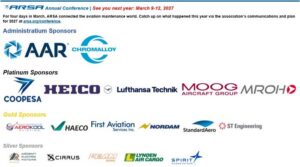
The image adorning ARSA emails from January through April.
The official “closure” of each year’s Annual Conference is the removal of the email insert providing event information and exposing sponsors from the bottom of team messages.
For the prior quarter, every team member email proclaims the support of its most committed members. Every communication from ARSA exposes the commitment of sponsoring companies to enhance the benefits of their investment.
With the 2026 chapter closed, the team and its industry quietly turn ahead. Members can continue benefiting while planning for next year’s Conference. Every day’s work coalesces on March 9-12, 2027.
As that work continues, take one more look at the companies that were exposed for their dedication to regulatory compliance in 2026 (stored in ARSA’s recordkeeping system) and consider: How can you be exposed in 2027?
Want more exposure? Here’s how to get it today – advertise with ARSA!
Levanto Voices Conference Highlights
 On March 30, Aviation Week’s MRO Podcast published its recap discussion of ARSA’s 2026 Annual Conference. Vice President of Operations Brett Levanto joined Editors Lee Ann Shay and Sean Broderick to recap the event.
Spend 22 minutes with Levanto, Shay, and Broderick to catch the highlights.
If the embedded player fails to load, visit https://aviationweek.com/podcasts/mro-podcast/podcast-what-actions-are-underway-cut-regulatory-burden-mros.
Were you at the Annual Conference? Click here to share your own highlights from the event – the association’s team utilizes feedback in its communications and to improve future events.
Want further background or discussion? Contact ARSA.
ARSA Works
What ARSA Has Done Lately – 1st Quarter 2026
Each quarter the board of directors receives reports on the association’s activities and fiscal health. In turn, the membership can step into the board member’s shoes with this overview of 2026’s first quarter.
Fiscal Health
The outstanding performance – 25 percent ahead of projected income – of the 2026 Annual Conference puts ARSA on strong footing for the remainder of the year. Another exposure for our most dedicated members.
Membership
The renewal rate for the first quarter exceeded 90 percent, with a higher number of new members joining. The total investment of new and recovered members in the quarter more than doubled the few canceling organizations.
Regulatory Advocacy
- Delivered joint (with the Aircraft Electronics Association) guidance to industry chairs of the Operations Specifications Working Group.
- Released draft update to guidance/cross-reference for compliance with the U.S./Canada MIP.
- Published response to multiple member questions regarding new FAA guidance for completion of Form 8130-3.
- Commented (with AEA) on Draft Advisory Circular 120-78B “Electronic Signatures, Electronic Recordkeeping, and Electronic Manuals.”
- Publicized extensive survey to make improvements to mechanic certificate knowledge test.
- Engaged with Airman Certification Standards Working Group to update the Regulations, Maintenance Forms, Records, and Publications sections.
- Shaped EASA-FAA Annual Safety Conference agenda.
- Foreign Repair Station D&A
Legislative Action and Lobbying
- Initiated 2026 lobbying efforts with focus on enacting:
- A full, clean FY 2027 appropriation for the Sec. 625 workforce grant programs.
- A National Defense Authorization Act that enhances access to maintenance data necessary to compete for and perform DOD contracts.
- Legislation to address DCA crash safety gaps identified by NTSB (ROTOR Act/ALERT Act).
- Incorporated Legislative Day attendee congressional visit information into BGOV congressional database.
Communication and Surveys
ARSA-placed Industry Editorials and Content
| AMT Magazine | How Aviation Professionals Can Maintain Public Engagement When Executive Agencies Disengage January 2026 | Christian Klein & Brett Levanto |
| How The FAA’s New Rule on Drug and Alcohol Regulations Impacts Repair Stations February 2026 | Brett Levanto |
|
| What Is Tactical Maintenance? March 2026 | Brett Levanto |
|
| Aviation Week | Why ‘OEM’ Is A Misleading Term In MRO Regulations January/February 2026 | Sarah MacLeod |
| New AMTs Prioritize Positive Workplace Culture March/April 2026 | Brett Levanto |
|
| DOM Magazine | Welcome to the Party Pal January 2026 | Brett Levanto |
| New Heights February 2026 | Brett Levanto |
|
| Wrongheaded and Shortsighted March 2026 | Brett Levanto |
ARSA in the News – Selected Industry Coverage
Danville aviation maintenance program aims to train a workforce for an in-demand industry
Cardinal News | February 26, 2026
Demand for aviation maintenance technicians is outpacing supply, according to a 2025 report from the Aeronautical Repair Station Association, the primary trade association for aviation maintenance.
FAA Moves To Allow Recognition Of Foreign Maintenance Certificates
AviationWeek | March 31, 2026
The FAA has launched a rulemaking that would enable the agency to recognize non-U.S. maintenance organization certificates through bilateral agreements—a long-sought step that affected certificate holders say will save them money and time.
2026 Annual Member Survey – Early Results
- Vast majority from repair stations/AMOs (93 percent) headquartered in the United States (88 percent).
- Seventy-four international locations represented.
- No respondents expect market contraction or workforce reduction.
- Membership Satisfaction Score: 4.58 (out of 5)
- Value of Association Benefits (out of 5):
- Regulatory Compliance Support (4.65)
- Access to Expertise (4.56)
- Regulatory Compliance Resources (4.30)
- Congressional Advocacy (4.23)
- Periodicals (4.21)
- Events (4.16)
- RSQM Compilation (4.03)
- Online Training (3.97)
- Advertisements (3.56)
- Most Pressing Risks Facing Industry (Percent of Responses [Multiple Selection]; Change Since 2025):
- Difficulty Finding Technical Talent (68%; +7)
- Availability of Maintenance Information (43%; +6)
- Regulatory Costs (36%; -4)
- Inconsistency of National Regulatory Enforcement (28%; +2)
- Overall Economic Uncertainty (25%; -11)
- International Inconsistency/Duplicative Oversight (25%; -3)
- Restrictions on International Trade (18%; -4)
Events, Meetings, and Training
2026 Annual Conference
- Feedback survey data (24 responses):
| Registration Process | 5.00 |
| Communication | 4.96 |
| IceBreaker Reception | 4.95 |
| Aerospace Happy Hour | 4.95 |
| Lessons from a Hall of Famer | 4.95 |
| Venue/Accommodations | 4.92 |
| Symposium General Sessions | 4.87 |
| E2E | 4.86 |
| Member Breakfast | 4.79 |
| Breakout Sessions | 4.79 |
| Overall Value | 4.75 |
| Online Resources/Livestream | 4.69 |
| Legislative Day | 4.58 |
- Most highly rated session from each component:
- E2E – Tariffs, Refunds, and Enforcement with Husch Blackwell (4.80)
- Legislative Day – Introductory Briefing (4.64)
- Symposium – Welcome & Introduction (4.82)
Workforce & Career Development
- Supported Aerospace Maintenance Council Competition at VERTICON.
- Assisted Choose Aerospace in review of maintenance scholarship applications.
Training
Concluded six-part webinar series on Safety Management Systems integration.
External Meetings
- Sarah held recurring meetings and engagement with both FAA Flight Standards and Aircraft Certification Services.
- Sarah had recurring meetings with Ric Peri of AEA.
- Sarah and Christian participated in multiple meetings supporting working groups associated with the Instructions for Continued Airworthiness Aviation Rulemaking Committee.
- Christian met multiple times with Joe Sambiase of GAMA on Industry Digitalization Working Group and other issues of mutual interest.
- Brett and Christian held frequent meetings with ATEC on collaborative issues.
- Christian and Brett held monthly collaboration calls with Oliver Wyman.
- Christian had multiple meetings to discuss tariffs.
- Sarah joined Sheri Baxter of the FAA at the Good Guidance Development Practical Application Workshop (Jan. 7)
- Christian attended a NATA Maintenance Committee meeting (Jan. 13).
- Brett spoke with Kelsey Zimmerman of the Mandala School about creating “focus unit” materials for early elementary school students (Jan. 13).
- Brett met with Stacey Rudser regarding MRO to Airline Pipeline (Jan. 20).
- Sarah, Christian and Brett met with member to discuss Foreign D&A testing program requirements (Jan. 22).
- Christian briefed foreign embassy transportation attaches regarding Foreign D&A testing program requirements. (Jan. 28).
- Christian met with Walter White to discuss strategy related to improving appropriations for workforce grant programs (Feb. 13).
- Christian met with the Maintenance Activity Group (Feb. 25).
- Sarah and Brett met with the DOT OIG IG Audit team.
- Brett participated in an Aviation Week podcast. (March 24).
Updated Repairman Application Resources
The personnel requirements of part 145 subpart D have always allowed repair stations to use repairman certificate holders as supervisors or individuals authorized to approve work for return to service.
ARSA’s model repair station documents include:
(1) Instructions for completion of FAA From 8610-3, “Airman Certificate and/or Rating Application – Repairman.”
(2) A template letter for use by a repair station to recommend its personnel for repairman certificates according to § 145.159.
These documents have been updated and re-released as part of the association’s combined RSQM Compilation. They are available as free “tools for members” along with the ARSA Model Forms Manual. Members seeking access to the updated documents can click here to request a .zip file containing every “tool” (even if you’ve downloaded the documents before, receiving them all ensures you get the most-updated versions as evidenced by the date of last modification).
For more information on ARSA’s work related to repairman certificates, visit arsa.org/repairmen.
How Consistent is the FAA?
Assist the Department of Transportation’s Office of Inspector General’s (OIG) audit of the FAA’s certification of part 145 repair stations.
The OIG intends to determine whether the FAA has sufficient controls in place to provide reasonable assurance that inspectors are consistent in interpreting and applying standards when certificating domestic repair stations.
Share experiences by completing the following survey. Individuals interested in being contacted by the OIG may opt to provide relevant details (If the embedded survey fails to load, visit https://www.surveymonkey.com/r/oig_rs_audit):
To read the audit announcement, click here.
Industry Guides FAA Towards Mutual International Acceptance
On April 13, ARSA and a group of aerospace trade associations provided the FAA with feedback on a rulemaking plan to establish international flexibility in the U.S. aviation safety rules. That feedback came at the agency’s request, which sought input from the organizations that had in 2020 petitioned the government to update 14 CFR part 43 to allow for direct recognition of foreign maintenance organization certificates under the United States’ bilateral aviation safety agreements.
“The proposed changes to §§ 43.3 and 43.7 would enable the FAA to significantly streamline the approval and compliance assurance processes for all affected parties,” the 2020 petition said. “The FAA would, of course, retain the right to negotiate the specific terms of any such arrangement with each bilateral partner, thereby assuring the FAA’s ability to exercise its State of Registry prerogatives as it does today.”
During ARSA’s Annual Conference on March 19, General Aviation Group Manager Chris Parfitt announced the agency had begun the process sought by the group’s petition. In a letter delivered to the association that week, the FAA described its early plans for the rulemaking and requested industry analysis of the deregulatory value of the resulting rule.
“Current rules forcing U.S. repair stations to maintain multiple foreign certificates are examples of ‘overregulation’,” the response letter supported by 13 associations said. “The proposed changes to part 43 will allow the FAA to enter into BASAs that recognize equivalent safety outcomes and impose fewer unnecessary burdens…The cost associated with obtaining a foreign maintenance certificate is a barrier to entry that disproportionately affects small businesses, which have less revenue over which to amortize duplicative compliance costs. Amending part 43 as proposed will provide the FAA with the discretion to enter into BASAs with trusted international partners that will benefit all maintenance facilities.”
The FAA intends to issue a notice of proposed rulemaking in early 2027. For a complete review of the issue and to see the 2020 petition, review the content at arsa.org/reciprocal-acceptance.
To review the complete letter to the FAA, click here.
In addition to ARSA, the following organizations joined the letter:
Aerospace Industries Association
Aircraft Electronics Association
Aircraft Owners and Pilots Association
Airlines for America
Aviation Suppliers Association
Aviation Technician Education Council
General Aviation Manufacturers Association
Modification and Replacement Parts Association
National Air Carrier Association
National Air Transportation Association
National Business Aviation Association
Vertical Aviation International
Levanto Challenges, Celebrates at MRO Americas
From April 21-23, ARSA Vice President of Operations Brett Levanto played multiple roles in telling the industry’s story during Aviation Week’s MRO Americas in Orlando, Florida.
While on-site to support the ARSA-sponsored Aerospace Maintenance Council Competition, Levanto made multiple onstage appearances on April 22. He joined Tom Hoferer, senior vice president of repair and engineering at association member AAR Corp, and Aero Norway CEO Neil Russell, in discussing “Critical Issues in MRO.” Making the most of the short panel charged with capturing everything “critical” in a sprawling industry, Levanto encouraged attendees to “look in the mirror” for compliance.
“Let’s be less concerned with what the authorities will do,” he said in response to a question about how the FAA and international civil aviation authorities can maintain “rigorous oversight.” “Instead, the industry’s responsibility is to rigorous in its demonstration of compliance and standing up for our collective responsibility for safety within performance based regulatory structures.”
The afternoon brought a far different audience: high school and college students from the Orlando area visiting the convention for aerospace industry exposure. After hype music and loud introductions, Levanto joined four panelists in continuing to “hype” maintenance careers.
“Focus on technicians for a second,” he said after imploring the students to recognize that every job is an aerospace job. “I’ll tell you our hidden secret: If you pursue work in maintenance, you’re going to be incredibly valuable to all of the businesses you saw downstairs [on the show floor] but you are going to be equally valuable any where you want to go.”
Emphasizing this final point, Levanto then fielded questions from the group. “There were aerospace engineering students considering additional technical education and high school aged private pilots weighing professional pathways,” he said after the event. “These kids are amazing and we have a place for them.”
While not on stage or behind-the-scenes at the competition, Levanto got out in support of industry colleagues. At the MRO Americas opening session on April 22, he helped spotlight Choose Aerospace Executive Director Crystal Maguire when she was called upon by Aviation Week President Greg Hamilton. He remained in the ballroom to celebrate the awarding of Airlines for America’s “Nuts & Bolts” Award to former A4A Vice President of Engineering & Maintenance (and longtime ARSA colleague) Bob Ireland.
For complete MRO Americas information, click here.
For a complete wrap of this year’s AMC Competition at MRO Americas including photos and resources for getting involved, click here to go to the Competition website.
Final Documents/Your Two Cents
This list includes Federal Register publications, such as final rules, Advisory Circulars and policy statements, as well as proposed rules and policies of interest to ARSA members.

Legal Brief
Editor’s note: This material is provided as a service to association members for educational and informational purposes only. It does not constitute legal or professional advice and is not privileged or confidential.
Court to FAA: You Can’t “Outsource” Justice
By Christian Klein, Executive Vice President
The U.S. Court of Appeals for the District of Columbia Circuit ruled against the FAA for failing to follow its own guidance in denying a certificate holder due process. The case involved an alleged refusal to submit to a drug test. The court underscored that certain government functions can’t be delegated. It also opined on when guidance affects individual rights, it becomes binding on the agency.
The story starts in Vietnam on March 20, 2024, where Ryan Paul, a pilot for cargo airline Amerijet International, Inc, was on vacation. He was expected back at his home base in Seattle by March 30 to resume flying in April. However, Paul contracted a severe sinus infection that delayed his return.
While recuperating in Vietnam, Amerijet notified Paul on April 2, 2024, that he had been activated for duty and selected for a random drug test. When directed to report for testing in Seattle that same day, he advised the company it was impossible for him to test. Amerijet took the response as a refusal to test, notified the FAA of the refusal, reported the refusal to the FAA’s Pilot Records Database (PRD), and terminated his employment.
Paul subsequently received a letter of investigation from the FAA’s Drug Abatement Division (DAD) regarding his refusal to test. After Paul explained the circumstances, the FAA advised that, while it was not taking legal enforcement action, the refusal to test was being referred to the FAA’s Office of Aerospace Medicine. Pursuant to 49 CFR § 40.285 he was prohibited from performing safety sensitive duties until completing the Substance Abuse Professional evaluation, referral, and education process.
When Paul urged the FAA to reconsider the refusal determination, the agency admitted: “in accordance with 49 CFR § 40.355(i), refusal determinations are made by the employer. The FAA did not make a refusal determination regarding Mr. Paul’s drug test.”
Paul’s petition for review with the U.S. Court of Appeals for the DC Circuit asked the court to:
(1) Vacate the FAA’s refusal finding,
(2) Affirm the FAA’s determination not to seek enforcement action,
(3) Compel the FAA to remove records of the alleged refusal from the PRD, and
(4) Direct the FAA to advise Amerijet that he had not refused to test.
The Court focused on “whether the FAA erred by failing to act – that is, whether the FAA must review an employer’s test-refusal determination.” The Court determined there were no regulations or statutes directing or prohibiting FAA’s review of refusal findings. The justices said 49 CFR sec. 40.355(i) was irrelevant because it addressed the relationship between employers and D&A service agents. Therefore, the Court turned to FAA guidance, in particular Order 9120.1E (“Drug and Alcohol Compliance and Enforcement Surveillance Handbook”).
That Order directs all program personnel to adhere to its procedures unless otherwise instructed by the DAD director and assigns two important responsibilities to the division:
(1) determining whether noncompliance (in this case, test refusal) exists, and
(2) evaluating whether compliance action is warranted.
There are repeated references to employer test refusal reports as “allegations” (not “determinations” or “findings”) and employee investigations can only result in two outcomes: legal enforcement action or no action.
The Court rejected the FAA’s argument that it is not required or authorized to review employers’ test refusal determinations, saying the agency’s position raised serious constitutional concerns. The Court also cited precedent that if the government delegates authority to a private entity, the government must retain the ultimate authority to approve, disapprove, or modify the private entity’s actions and decisions on delegated matters.
“[I]f the FAA is correct that it bears no responsibility to review private employers’ determinations that their employees refused a government mandated drug test, then those employers would effectively ‘decide who can’ fly ‘under federal law’ ‘without any [government] review of [their] decision[s] on the merits,’” the Court said. It also cited other consequences emanating from the refusal determination: the report to the PRD and bar on performing a safety sensitive function for an employer before completing the return to duty process.
Given the “serious constitutional overtones” in the case (i.e., whether he had been denied due process), the Court followed past holdings that in limited circumstances nonlegislative rules (in this case, the Order) may be binding on an agency when they affect an individual’s rights.
“[W]e interpret the Handbook to require FAA review of private employers’ test-refusal determinations. Declining to enforce that requirement against the FAA and leaving the test-refusal determination entirely to the discretion of private employers would raise severe constitutional concerns. … the FAA concedes that it did not follow that requirement,” the Court said.
Rather than evaluating whether Paul had refused to test, the Court remanded the case to the FAA to “follow its own procedures and conduct the necessary review.”
So, what are the takeaways?
First, the FAA must do its job. In this case, that means reviewing employer refusal determinations as directed in the agency’s own guidance. D&A testing due process can’t be outsourced to the employer.
Second, while agency guidance is not binding on the government, the case reminds us it can become so when individual rights are affected.
Finally, question authority. Paul was put in an impossible position that led to an absurd outcome. Rather than rolling over, he stood up to the agency and questioned its decision-making. His case is a reminder that citizens need to hold the government accountable.
Layman Lawyer
Editor’s note: This material is provided as a service to association members for educational and informational purposes only. It does not constitute legal or professional advice and is not privileged or confidential.
To Know Flexibility is to Love It
By Brett Levanto, Vice President of Operations
“Reciprocal acceptance” is a big story from ARSA’s 2026 Annual Conference. The FAA announced the rulemaking to be flexible in mutual recognition under bilaterals was “definitely happening.”
In the same session, the agency confirmed “any day now” a final rule would publish in the Federal Register removing the burden from repair stations to maintain “current and accessible” versions of certain documents and data.
The FAA’s 2024 proposed rule acknowledged existing flexibility in the rules:
“The prescriptive list [of required data] … conflicts with § 43.13(a) … Repair stations may also use other documents (including a manual revision that pre-dates the current version if the maintenance is performed using other acceptable methods, techniques, and practices) … If a repair station were to use “other methods, techniques, and practices acceptable to the Administrator” (for example, those contained in a prior manual revision), then the repair station would not be required to use the latest revision provided by the manufacturer.”
Laymen lawyers in aerospace should utilize the power of this flexibility. “Other data acceptable” can be read broadly in compliance and FAA enforcement discretion should support such interpretation. As noted in the rulemaking preamble and a referenced 2010 legal interpretation, § 43.13(a) allows alternative methods to those in the instructions for continued airworthiness or manufacturer’s maintenance manual.
As explained in ARSA’s training “What is ‘Acceptable to the Administrator’?”, the performance-based conclusion of the rule’s plain language is clear: Methods, techniques, and practices are acceptable when the return the article worked on to at least its original or properly altered condition as required by § 43.13(b). As the idiom goes, the proof of the pudding is in the eating.
Developing and substantiating these “other” methods requires demonstrated repeatability. Maintenance actions taken under these instructions is to be documented through experience and/or training. Substantiating data must be approved for major repairs or alterations, but maintenance instructions must be repeatable and technically sound.
Regardless of the “any day now” action by the agency to clarify the rules for repair stations, maintenance providers must know and love the flexibilities provided for capability technical personnel to do the job correctly.
ARSA on the Hill
Going But Not Gone
By Christian Klein, Executive Vice President
Rep. Sam Graves (R-Mo.) announced his retirement from Congress at the end of the current term. A passionate private pilot, Graves has represented Missouri’s 6th congressional district since 2001, chaired the House Transportation and Infrastructure (T&I) Committee since 2023 and previously served as the committee’s ranking member.
Chairman Graves was a champion for solving the aerospace workforce crisis. His support for the Sec. 625 workforce grant program first proposed by ARSA earned him (and fellow T&I Committee member and champion Dan Lipinski (D-Ill.) ARSA’s 2019 Legislative Leadership Award. Given his firsthand experience with the FAA, Graves has also worked hard to improve the agency’s oversight.
Graves will be best remembered by ARSA and its allies for the 2024 FAA Reauthorization Act. Together with T&I Committee Ranking Member Rick Larsen (D-Wash.) the legislation, widely regarded as the best FAA reauthorization bill in decades, was successfully steered through a narrowly divided Congress during an election year, a remarkable feat.
Graves may be retiring in January 2027, but made his full engagement clear by stating: “Although I have announced that this will be my last term serving as the Representative from the Sixth District of Missouri, we’ve still got a lot of work to do at the Committee…and I intend to finish strong.”
On the T&I Committee’s priority list for 2026 are reauthorizing federal surface transportation programs, the Water Resources Development Act reauthorization, and the ALERT Act, which seeks to close safety gaps identified by the National Transportation Safety Board (NTSB) in its report on the 2025 DCA collision (see below).
Graves’ successor as T&I Chairman will depend on the outcome of the 2026 congressional elections. Under a Democratic House, the next chairman will almost certainly be Larsen. If Republicans maintain the majority, the next chairman will be selected by the House Republican Steering Committee from among the committee’s senior Republican members. Whoever holds the gavel will oversee the next FAA reauthorization, so ARSA will be following the chairmanship race closely.
DCA Crash NTSB Findings Bill Passes House
On April 14, the House passed the bipartisan Airspace Location and Enhanced Risk Transparency (ALERT) Act of 2026 (HR 7613) by a vote of 396 to 10. The bill addresses safety issues raised by the NTSB’s investigation of the 2025 midair collision between American Airlines Flight 5342 and a UH-60 Army Black Hawk helicopter at DCA.
Among other things, the ALERT Act:
- Requires Automatic Dependent Surveillance–Broadcast (ADS-B) and a corresponding collision prevention technology to be equipped and operating on virtually all aircraft that are required to have ADS-B Out, by December 31, 2031;
- Requires updates to helicopter route safety and separation requirements and air traffic control training, processes, and procedures;
- Seeks to objectively define a close proximity encounter and requires the FAA to establish a database to effectively monitor such encounters and other data for trends;
- Addresses FAA management issues that contributed to the fatal collision;
- Strengthens safety standards for military aircraft and cooperation between the military and the FAA;
- Enhances requirements and guidance for collision avoidance technology for military aircraft;
- Strengthens oversight of flight operations in congested airspace; and
- Requires enhanced flight data sharing between the Secretary of Defense and the FAA.
A conference committee will reconcile the House’s ALERT Act with the Rotorcraft Operations Transparency and Oversight Reform Act (ROTOR) Act (S. 2503), which passed the Senate in December. Among the key differences:
Technology mandates: The ROTOR Act more broadly requires ADS-B In for all aircraft; the ALERT Act directs a negotiated rulemaking and final rule within two years to require all civil aircraft operating in Class B and C airspace to have ADS-B In by the end of 2031.
Scope: The House bill is more comprehensive and seeks to address all 50 NTSB recommendations; the ROTOR Act (which was introduced before the NTSB report was finalized) focuses specifically on issues associated with the DCA crash.
Military: The ROTOR Act has stricter limits on when military aircraft can operate without ADS-B Out.
For a more comprehensive comparison from the Eno Center for Transportation, click here.
ARSA is urging House and Senate aviation and defense policy leaders to roll up their sleeves, work with industry, and quickly enact a consensus bill that closes the safety gaps while being mindful of the time needed to develop, certify, and install new technologies.
Training & Career Development
Make ARSA Training Work
ARSA’s online training program represents its most-valuable benefit to the aviation industry: knowledge gained through training and experience. The association’s team has turned its decades of work on behalf of aviation maintenance into more than 80 hours of on-demand content.
While sessions are available for registration at any time – ARSA member discounts available – companies can also incorporate the association’s training into their regular programs:
(1) Subscription. Make up-front, bulk purchases of training hours. The details of each subscription can be customized, including focus on specific subject areas (e.g., human factors) or options for specially-priced session access after the initial hours have been used.
(2) “Championing” a session. Guarantee a certain number of attendees for training in a particular topic that will also be made available for general registration. Variations include open registration for a live session (i.e., company personnel participate at the same time as general registrants) or a company-specific live event for which a recorded version (not including any company-specific information) is made available for on-demand registration.
(3) Tailored training. Contract ARSA’s management firm Obadal, Filler, MacLeod & Klein, P.L.C. to produce or modify training specific to your organization. The team can then re-record it (or offer it as a separate live session) for ARSA’s training program. Tailored programs are priced differently from ARSA’s hourly rate and are administered by OFM&K, which allows for a client engagement and related attorney-client privilege for all discussion.
For more information about ARSA’s training program, review the menus below. If you have questions or would like to learn more about ways to integrate ARSA training into your own program, contact Vice President of Operations Brett Levanto (brett.levanto@arsa.org).
Government employees: Contact ARSA directly for auditing opportunities.
Registration: Registration and payment may be processed directly through the training platform/course catalog (free account creation required).
Technical questions and assistance: Click here for FAQ and technical support from training platform vendor.
Refunds: No refunds are granted for ARSA training sessions. When classes are canceled, registrants can choose from future courses of equal value. If a registrant is unable to attend a live session, their registration allows access to the on-demand, recorded version of the webinar.
IA Approval: A number of ARSA training sessions have been accepted for Inspection Authorization (IA) renewal credit. These sessions are denoted on their registration page with their FAA course acceptance number (in red).
Benefits: Registration for an ARSA-provided training session includes:
- Access to the live class session on the scheduled date (if applicable).
- Unlimited access to the on-demand, recorded version of the webinar to be made available after the live session is complete (or at time of purchase, for on-demand classes).
- A copy of the presentation and all reference material with links to relevant resources and citations.
- A certificate* upon completion of the session as well as any required test material.
OFM&K Training Portal: All of ARSA's training sessions are provided through OFM&K's training portal. As the training provider of choice for ARSA and a trusted resource for the aviation community, the firm's training materials represent a vital tool for entities pursuing regulatory compliance and business success. All of the courses are administered via PotomacLaw.InreachCE.com, which is not part of ARSA's website.
Complying with Part 145 – “Soup to Nuts” (Four Hours) Instructor: Sarah MacLeod Description: Specially recorded with a hand-picked audience for interactive discussion, this session thoroughly reviews 14 CFR part 145, discusses the application of the rule and overviews some practical implications of obtaining and maintaining a repair station certificate. Pricing Note: This is a four-hour session and is $300 for members and $600 for non-members. Click here to register and get access for 90 days.
Sessions Accepted for IA Renewal Credit Eight of ARSA's on-demand training sessions have been accepted by the FAA for Inspection Authorization renewal credit under 14 CFR § 65.93. Each session is currently available for registration and immediate access:Click here to purchase all eight sessions (plus one required prerequisite) at a “bundled” discount – let ARSA take care of your IA renewal requirements this year. Click here to purchase all eight sessions (plus one required prerequisite) at a “bundled” discount.
Aircraft Parts
Audit Activism & Prophylactic Lawyering
Drug & Alcohol Testing
Human Factors
Instructions for Continued Airworthiness
Parts 21, 43, 65, 145 (and others)
Public Aircraft"Going Global" - International Regulatory Law
Grassroots Advocacy
Recordkeeping – "Finishing the Job with Proper Paperwork"
The Fourth Branch of Government (Administrative Agencies and Procedures)
Self Disclosure Programs and Practices
(1) Subscription. Make up-front, bulk purchases of training hours. The details of each subscription can be customized, including focus on specific subject areas (e.g., human factors) or options for specially-priced session access after the initial hours have been used.
(2) “Championing” a session. Guarantee a certain number of attendees for training in a particular topic that will also be made available for general registration. Variations include open registration for a live session (i.e., company personnel participate at the same time as general registrants) or a company-specific live event for which a recorded version (not including any company-specific information) is made available for on-demand registration.
(3) Tailored training. Contract ARSA's management firm Obadal, Filler, MacLeod & Klein, P.L.C. to produce or modify training specific to your organization. The team can then re-record it (or offer it as a separate live session) for ARSA’s training program. Tailored programs are priced differently from ARSA’s hourly rate and are administered by OFM&K, which allows for a client engagement and related attorney-client privilege for all discussion.
For more information about ARSA's training program, review the menus below. If you have questions or would like to learn more about ways to integrate ARSA training into your own program, contact Vice President of Operations Brett Levanto (brett.levanto@arsa.org).The association’s training program is provided through Obadal, Filler, MacLeod & Klein, P.L.C., the firm that manages ARSA. To go directly to OFM&K’s online training portal, visit potomaclaw.inreachce.com. To learn more about the association’s training program and see course availability, visit arsa.org/training.
What training do you need? Contact ARSA to let the association know and help get it developed.
ARSA Partner Wins Grand Laureate

Choose Aerospace representatives, including ARSA VP of Operations Brett Levanto and member representatives Ryan Goertzen (AAR Corp) and Etain Connor (FEAM Aero) celebrate the organization’s Grand Laureate Award.
In late March, Choose Aerospace was named the Grand Laureate winner in the Maintenance, Repair and Overhaul (MRO) category at the Aviation Week Network 68th Annual Laureate Awards.
Choose Aerospace is a mission-driven non-profit supported by ARSA, it’s board, and a host of aerospace community stakeholders, including partner associations and member companies. It was recognized for its High School Aviation Maintenance Program, which provides students with FAA-aligned curriculum and an industry-recognized credential.
The program is designed to give students a direct pathway toward careers in aviation maintenance. Since its launch in 2020, it has reached nearly 2,000 learners across more than 40 programs, helping to address the industry’s ongoing need for a skilled maintenance workforce.
The Laureate Awards recognize extraordinary achievements across the global aerospace, aviation, and defense industries. Grand Laureate winners represent the highest level of recognition within each category. Choose Aerospace highlights the impact of early pathway programs in strengthening the aviation maintenance talent pipeline and expanding access to high-demand technical careers.
The Competition Was Fierce
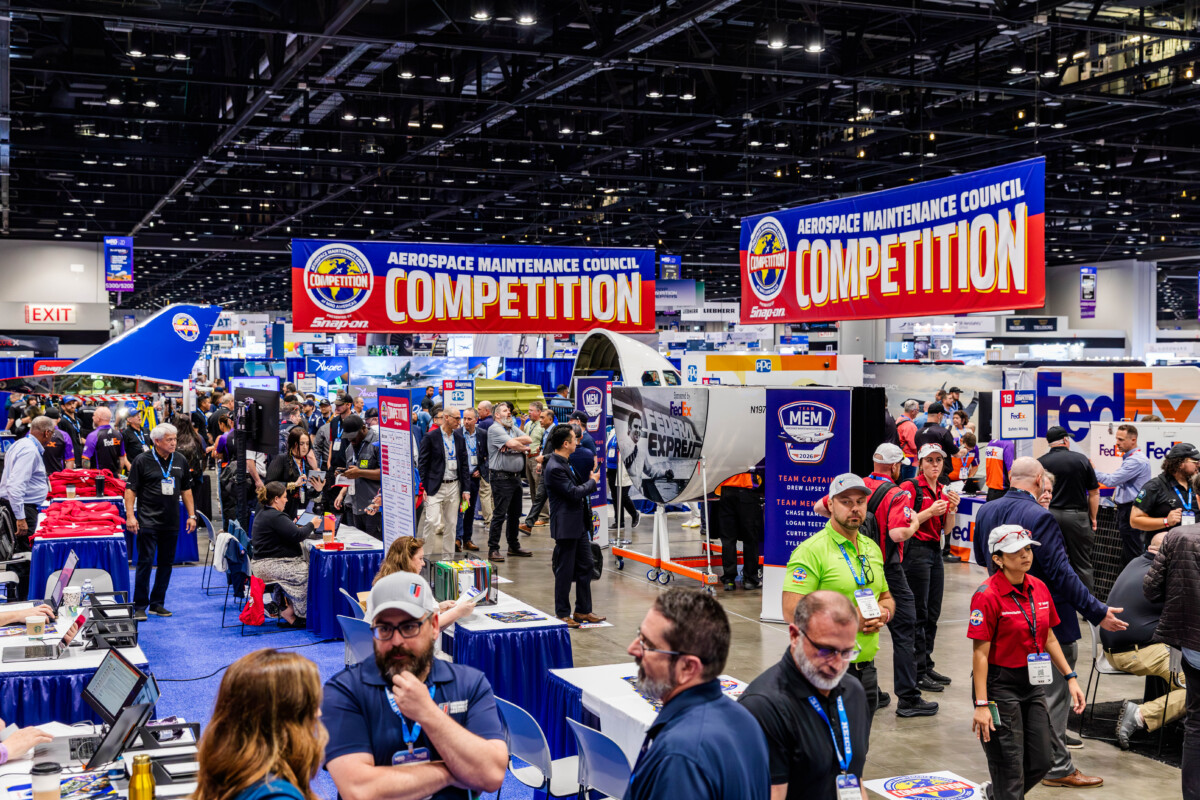
The 2026 AMC Competition was the largest ever. Photo courtesy AMC.
On April 23, the 2026 Aerospace Maintenance Council Competition hosted on the exhibit floor of Aviation Week’s MRO Americas wrapped. Five-member teams from schools, industry, and the military competed in maintenance events intended to test skill and knowledge required of an aviation technician. Though the official reason for each team to gather in Orlando was technical performance, the event is a showcase for the skill and comradery inherit in aerospace maintenance work – a celebration of the industry’s past, present, and future.
The 2026 ARSA-sponsored event was AMC’s largest ever, with 87 teams competing across 29 maintenance task-based challenges. Next year will bring further growth: The Competition will spread internationally for the first time with an appearance at MRO Asia-Pacific 2027 in Singapore. For a complete wrap of this year’s event at MRO Americas including photos and resources for getting involved, click here to go to the Competition website.
Competition Awards
Top Overall: Team 48 FedEx Express – Team MEM
Paul Cousins Award (top international team): Team 84 Air Canada – Team 2
Category Awards
General Aviation Category
• First Place: Team 71 Aircraft Engineers International
• Second Place: Team 55 Victory Lane Aviation
• Third Place: Team 69 Textron Aviation – Orlando
Military Category
• First Place: Team 67 United States Army – 128th Aviation Brigade – Team Chinook
• Second Place: Team 66 United States Army – 128th Aviation Brigade – Team Blackhawk
• Third Place: Team 82 United States Air Force – 4th MXG

An AMC Competition competitor participates in the Transparencies event provided by ARSA Member PPG Aerospace. Photo courtesy AMC.
MRO/OEM Category
• First Place: Team 48 FedEx Express -Team MEM
• Second Place: Team 75 Southwest Airlines – Team Colleen
• Third Place: Team 76 American Airlines – Team Base
Commercial Category
• First Place: Team 72 FedEx Express -Team Indy
• Second Place: Team 63 Southwest Airlines – Team Herb
• Third Place: Team 78 United Airlines – Line
School Category
• First Place: Team 9 Tulsa Tech – Adult Students
• Second Place: Team 14 Universal Technical Institute – Houston
• Third Place: Team 47 Tarrant County College
Professionalism Awards
United’s John Goglia Competing with Professionalism Award (cash awards, determined by judge vote):
• First Place: Team 86 Embry Riddle – Team 1
• Second Place: Team 7 Chennault Aviation Maintenance Academy
AMC Peer Team Award (determined by team vote): Team 11: Centennial College – Team 1
AireXpert Dream Team Award (determined by online vote): Team 9: Tulsa Tech – Adult Students
AMC Professionalism Award (determined by judge vote)
• Professional: Tiffany Gray, US Army – Team Chinook
• Student: Jeremy Janes, Chennault Aviation Maintenance Academy
Industry Scholarships
Test grants provided by Northrop Rice Foundation ($350):
• Callum Richman, AIM Phoenix
• Alexander Ruger, UTI Houston
• Shelby Nelson, Lane Community College
• Lei Huot, Embry-Riddle Aeronautical University
Phoebe Omlie Scholarships
(more information on the award here)
Provided by AMC ($1,000): Barbara Rivas Quezada, San Bernardino Valley College
Provided by AA ($2,500 ea):
• Samantha Tijerina, Chennault Aviation Maintenance Academy
• Jeremy Lynch, Vaughn College
• Jacqueline Wilson, Embry-Riddle Aeronautical University
• Andrew Cornell, Chennault Aviation Maintenance Academy
Provided by TechForce Foundation ($2,000): Clarissa Sanchez, Charlotte Technical College
Provided by Chix Fix ($1,250): Eliza DeBry, Idaho State University
Provided by Aviation Workforce Solutions ($2,000): Trevor Hill, Liberty University
Provided by Jsfirm.org ($1,500): Ivan Moon, Eastern New Mexico University
Provided by GE Aerospace ($2,000): Austin Parrish, Florida State College at Jacksonville
Regulatory Compliance Training
Test your knowledge of 14 CFR §§ 21.50(c), Commercial Parts Lists.
Click here to download the training sheet.

Membership
Exposing Others
Receipt of ARSA’s monthly newsletter, the hotline, indicates your company is a member of the association.
Are you taking advantage of all the association benefits?
Are your colleagues receiving the newsletter and other benefits?
Don’t know?
Check out the member directory to find the company or use “ASK ARSA” to submit a regulatory question, request publications, or merely to find out more.
ARSA encourages member registrants to expose themselves to a wealth of knowledge and tools to navigate the aviation safety regulatory realm.
Nobody Exposes You Like ARSA
ARSA Annual Conference sponsors are exposed numerous times for their contributions. How does this happen? Let’s count the ways.
(1) In newsletters. In the weeks before the Annual Conference, sponsor acknowledgements are provided in two or three distributions each month.
(2) In emails. When the Conference “season” starts, sponsor acknowledgements are added to email “signatures”; messages going to EVERYONE for a quarter of the year, equating to thousands of exposures.
(3) Signage. Sponsor signs during the event expose the logo by category of sponsorship. It is seen most often near the registration desk where everyone exposes themselves to receive an event badge.
(4) The agenda and Online Toolbox expose the sponsors for every component of the event.
(5) Tent Cards, lanyards, room keys, and more. A series of tent cards crisscross the room or event space celebrating the contribution of the sponsor. Lanyards, online resources, or room keys, tent cards pop up constantly, exposing participants to the sponsor’s commitment.
(6) Dedicated feed. During every break of the event, an “endless loop” of exposure reminds participants of the association’s sponsors.
(7) From the stage. Before and after each scheduled events team members expose the sponsors involved, singling out those responsible for the contribution.
Exposure of the 2026 Sponsors will extend throughout the year.
Join them in 2027, start by visiting the event page for basic information and contacting Michael O’Born.
Welcome & Welcome Back – New & Renewing Members
ARSA’s members give the association life – its work on behalf of the maintenance community depends on the commitment of these organizations. Here’s to the companies that joined or renewed in March and April:
March New Members
Advanced Turbine Systems LLC, R02
Vargas, Kimberly “Kim”, Mil
March Returning Members
Accurate Accessories, LLC, R01, 2022
AEE-EMF, Inc., R01, 2009
AERO Component Repair, LLC, R01, 2011
AeroKool Aviation Corp, R03, 2017
Aircraft & Component Technical Services, LLC, R02, 2009
Aircraft Specialists Inc., R02, 2023
AIRTEC, Inc., R02, 2024
All Nippon Airways Company, Ltd., Assoc, 2001
Answers Aerospace Engineering LLC, R01, 2021
ATP USA, Inc.-, R01, 2017
Av8 MRO, LLC-31166, R03, 2014
Aviation Instruments Repair Specialists (AIRS), Inc., R03, 2022
Cadorath Aerospace Lafayette, LLC, R03, 2005
Cargo Systems, Inc., R01, 1999
Chromalloy, Enterprise, 1993
DRJ Technologies, R02, 2025
Erickson Incorporated dba Erickson Air-Crane, R01, 1997
Flightstar Aircraft Services, LLC, R04, 2020
Gardner Aviation Specialists, Inc. dba Precision Aviation Group, R01, 2018
HIGH CLASS MRO INC, R01, 2025
Honeywell International, Inc., Enterprise, 1996
Jet Air MRO, LLC, R02, 2025
Liebert Aviation, LLC dba Performance Flight, R02, 2023
L.J. Walch Co., Inc., R03, 1985
PropWorks Propeller Systems, R02, 2021
SONICO, Inc., R02, 1995
Thales Avionics, Inc., R04, 2006
Toledo Jet Center, LLC, R03, 2010
TAE Aerospace, Inc., R01,
WGI, Inc. dba Westfield Gage Company Overhaul and Repair, R03, 2018
April New Members
ACMT, Inc. dba ACMT, Inc. Advanced Composites & Metalforming Technologies, R02
GO Aerospace Services, L.L.C., R01
Jeffrey R. Reynolds, MIL
Med-Craft LLC dba Med-Craft, Inc., R04
Prime Engine Accessories LLC, R01
April Returning Members
Aerocopter Component Services Ltd., R01, 2025
Aerospace Quality Research & Development 145, LLC, R01, 2006
AOG Aviation Spares LLC, R03, 2025
AOG Reaction Company dba AOG Reaction, Inc., R02, 1993
Cirrus Design Corporation, Assoc, 2025
Earp Aviation Repairs, LLC, R02, 2019
Ford Instruments & Accessories, LLC, R01, 2018
Farsound Aviation Limited, Assoc, 2023
GA Telesis Component Repair Group Southeast, LLC, R04, 2022
Metro Aviation, Inc., Assoc, 2003
Ohlinger Industries, Inc., R04, 2006
Pac West Helicopters, Inc., R01, 2009
S3 AeroDefense, LLC, R03, 2010
SAFETECH USA, INC., R02, 2002
Southwest Aerospace Technologies, LLC, R01, 2019
Tarrant County College, EDU, 1993
Vibrant Corporation, R02, 2021
ARSA Board Welcomes Smith, Kirstein
During its second quarterly meeting of 2026, ARSA’s Board of Directors elected AAR Vice President and Chief Quality Officer Art Smith and Lufthansa Technik (LHT) Vice President of Quality Management Michael Kirstein to serve as volunteer leaders of the association.
Smith started his career in the Air Force, has been involved in the civil maintenance industry since 1988, and has held positions at Delta Airlines, Bombardier Aerospace, in addition to AAR. Kirstein has held numerous leadership roles within LHT and its affiliates since 2005, including as managing director of LHT Landing Gear Services UK, president and CEO of Hawker Pacific, and LHT vice president of operations engine services.
ARSA’s nine elected Board members are selected to ensure all segments of the maintenance industry and all types of companies (small/medium/large, publicly/privately owned, etc.) are represented. Smith was elected to fill the seat vacated by Bryan Scott after AAR Corp’s acquisition of HAECO Americas. Kirstein steps in for departing director Janina Bergmann as she moves into a new professional role precluding ARSA service. Both will serve out the terms of their predecessors and will stand for re-election in October of next year.
While both new directors represent large, international corporations, their long experience will support the association as it represents the entire global maintenance community. To learn more about ARSA’s Board, visit the governance web page and check in on “What ARSA Has Done Lately” in this edition of the hotline.
A Member Asked…Block 12?
Q: This question is regarding the FAA Form 8130 Block 12 requirements.
We currently utilize manufacturer maintenance manuals (or ICA), as well as supplemental information as applicable/approved by the agency or the customer. Below is an example of our current block 12 verbiage:
“The work specified in block(s) 11/12 accomplished with reference to CMM NUMBER, Rev. LEVEL and DATE with applicable supplemental information, Rev. NUMBER DATED PUB. NUMBER”
In an attempt to simplify the language going forward, we would like to update the verbiage to:
“The work specified in block(s) 11/12 accomplished per CMM NUMBER, Rev. LEVEL and DATE. See attachment Work Order/Shop Findings Report NUMBER for details of work accomplished.”
The company’s supplemental information will be included as part of the work order/Shop Findings Report referenced.
We reviewed AC 43-9D, and found that paragraph B.12.1 states:
“In block 12, describe the work performed that is identified in block 11, and the associated results necessary for the user or installer to determine the airworthiness of the product or article in relation to the work being certified. This can be done either directly OR BY REFERENCE TO SUPPORTING DOCUMENTATION. If additional attachments are part of the FAA Form 8130-3 return to service, such as FAA Form 337, Major Repair and Alteration (Airframe, Powerplant, Propeller, or Appliance), or other pertinent documentation, annotate “See attachment(s) [insert here]”. Attachment(s) must have traceability to the FAA Form 8130-3.” (Emphasis added.)
We feel our updated block 12 verbiage would align with the guidance in AC 43-9D, however, when we notified the local FAA office of our planned verbiage update, they adamantly did not agree the guidance was met.
So, we are now reaching out to the great regulatory minds of ARSA for their expert opinion regarding our proposed updated block 12 verbiage.
A: Thank you thinking there are great regulatory minds at ARSA!
Whether or not the abbreviated language complies with the FAA’s advisory material may or may not matter if the agency’s representative has another opinion, so ARSA will not opine on that nuance.
ARSA can say that the regulations that apply to maintenance records are contained in § 43.9 and for repair stations in sections 145.209(i), 145.211(c)(3), 145.213, and 145.219.
The agency itself has opined on what needs to be in a section 43.9 record, and it ain’t much—see this result: drs.faa.gov/browse/excelExternalWindow/53242B4715E974F786257F50004A4DE6.0001
Repair stations must follow the manual which must describe the records and recordkeeping system. Additionally, a repair station must provide samples of its maintenance forms and instructions for completion under section 145. 211(c)(3). The repair station must keep records showing compliance with part 43 (section 145.219(a)).
Maintenance records must contain the information required by section 43.9 – and the “maintenance release” (section 43.9(a)(4) must be provided to the customer (section 145.219(b)). The FAA Form 8130-3 is the “maintenance release”; it may reference other documents that establish compliance with the other elements of section 43.9, including a more complete description of the work performed (section 43.9(a)(1), names of all individuals and contractors that performed work (section 43.9(a)(2), and other customer driven information, like parts replaced, teardown reports, etc.
If the “maintenance release” meets the applicable requirements of the regulations, ARSA would say compliance with section 43.9 has been achieved. That said, you must evaluate the requirements of other regulations that may apply.
Finally, for your information, EASA expects the references to the maintenance data used to be included in Block 12—so your shortened version may not pass a receiving inspection by an EASA carrier or repair station, but then again, it may!
Protect Your Inbox (and ARSA’s Reputation)
On April 7, ARSA learned of a SPAM email sent using a team member’s credentials with the subject “Kimberly Dimmick shared Aeronautical_Repair_Station_Invoice” with you”. This message is not legitimate.
What to do…
Follow your company’s procedures for SPAM/malicious email regarding disposal of that specific message. If you receive any other outreach claiming an ARSA connection and you are unsure about its validity:
(1) Review the outline of ARSA’s communications practices at arsa.org/safesenders to see how the message could fit.
(2) Contact ARSA Vice President of Operations Brett Levanto for further clarification or to report a fraudulent message.
(3) If/when you are sure the message is fraudulent, submit a report to reportfraud.ftc.gov or an equivalent government entity if you are located outside the United States.

For more information about protecting yourself from email-based scams, visit the U.S. Federal Trade Commission website.
Resources
ARSA strives to provide resources to educate the general public about the work of the association’s member organizations; should you need to provide a quick reference or introductory overview to the global MRO industry, please utilize AVMRO.ARSA.org.
Careers in Aviation Maintenance
How do you share the industry’s story with the people who could be its future? Teach them about the great work done every day to keep the world in flight. (Even if we can’t recruit somebody, we sure can make them thankful for our work.)
ARSA Member Benefits
From access to industry expertise to growing your own through education and training, ensure your company gets the most out of its investment in ARSA.
Industry Meetings & Events
| Event/Meeting | Dates | Location |
| NBAA Maintenance Conference | 5/5-7/2026 | New Orleans, Louisiana |
| FAA-EASA International Safety Conference | 6/16-18/2026 | Chantilly, Virginia |
| MRO BEER | 6/17-18/2026 | Istanbul, Turkey |
| Farnborough International Airshow | 7/20-24/2026 | Farnborough, United Kingdom |
| EAA Airventure | 7/20-26/2026 | Oshkosh, Wisconsin |
| LABACE | 8/4-6/2026 | Sao Paolo, Brazil |
| AeroEngines Europe | 9/1-2/2026 | Lisbon, Portugal |
| ATEC Fly In | 9/22-25/2026 | Washington, D.C. |
| NBAA BACE | 10/20-22/2026 | Las Vegas, Nevada |
| ARSA Annual Conference | 3/9/-12/2027 | Arlington, Virginia |
the hotline is the monthly publication of the Aeronautical Repair Station Association (ARSA), the not-for-profit international trade association for certificated repair stations. It is for the exclusive use of ARSA members and federal employees on the ARSA mailing list. For a membership application, please call 703.739.9543 or visit arsa.org/membership/join. For information about previous editions, submit a request through arsa.org/contact. This material is provided for educational and informational purposes only. It does not constitute legal, consulting, tax or any other type of professional advice. Law, regulations, guidance and government policies change frequently. While ARSA updates this material, we do not guarantee its accuracy. In addition, the application of this material to a particular situation is always dependent on the facts and circumstances involved. The use of this material is therefore at your own risk. All content in the hotline, except where indicated otherwise, is the property of ARSA. This content may not be reproduced, distributed or displayed, nor may derivatives or presentations be created from it in whole or in part, in any manner without the prior written consent of ARSA. ARSA grants its members a non-exclusive license to reproduce the content of the hotline. Employees of member organizations are the only parties authorized to receive a duplicate of the hotline. ARSA reserves all remaining rights and will use any means necessary to protect its intellectual property.
© 2026 Aeronautical Repair Station Association