


2026 – Edition 5 – June 5

Table of Contents
Note: The order of material varies in hotline emails, but is always presented the same on this landing page. Readers scrolling through content on or printing this page will find it organized consistent with the table of contents.
President’s Desk
The Joys of Summer
One summertime joy is the FAA/EASA International Aviation Safety Conference. Alternatively hosted each year in the United States and European Union, the Conference provides the highest-possible-level venue for aviation safety discussions.
This year’s installment lands in greater Washington, D.C. from June 16-18, with an agenda reflecting key issues facing the international world of aviation maintenance. Since what’s said during the event is miles from the day-to-day work of aerospace professionals – ARSA attends and participates.
ARSA’s team is a collective voice; this year, the executive team will be onsite in Chantilly, Virginia and Executive Vice President Christian Klein will moderate a panel on digitalization and the supply chain.
The event, hosted by American Association of Airport Executives, also includes presentations and “quick talks” on safety management systems, foreign repair station drug and alcohol testing program requirements, certification, and technology issues.
Representing its members is a joy for the association’s team, even when it requires attending a government meeting. The association will let us know about the participation of members and the useful information exchanged among the authorities and the industry.
 |
John Riggs 2025 ARSA president | Director of Airworthiness, Chromalloy |
ARSA Works
Celebrating Charlie with Fortner, AAR

Charles Taylor
Charles Taylor, the Wright Brothers’ mechanic and father of aviation maintenance, was born on May 24, 1868. Now – 158 years later – we celebrate him through continued commitment to good work.
In 2008, a congressional resolution dedicated the date in honor of Taylor, establishing National Aviation Maintenance Technician Day. While the “holiday” doesn’t get anyone out of work (there are no days off from aviation safety), it’s important to celebrate the commitment, integrity and skill of every aircraft mechanic and all those who support them – this is Taylor’s legacy and our shared responsibility.
2026 Member Celebrations
Click here to share yours.
Fortner Engineering – Hot Chocolate, Doughnuts, and a Paper Airplane Contest
The company offered sweet treats for all personnel – acknowledging the value of complete team support for maintenance activities – and gathered four teams of five technicians in a paper airplane contest.
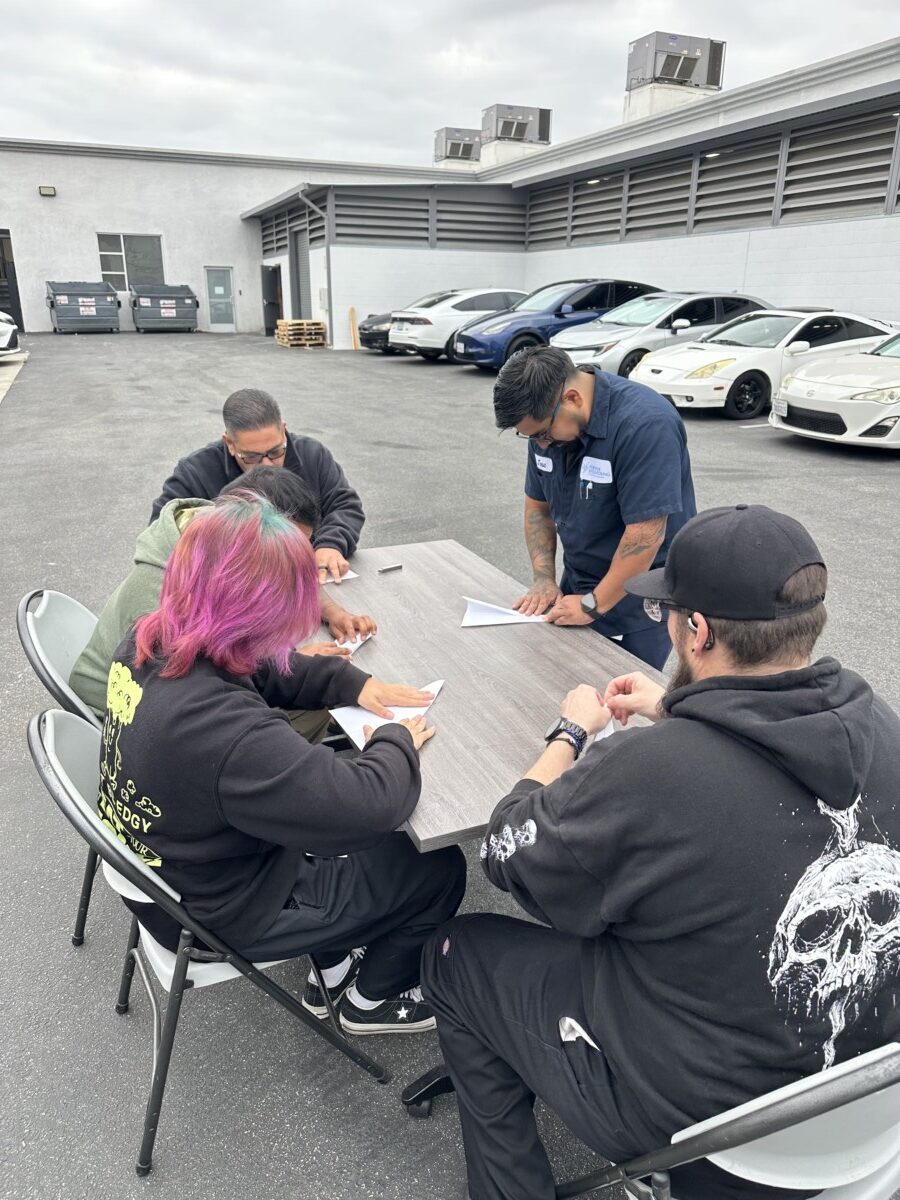 Fortner Engineering Personnel design and produce their competition-grade paper airplanes. |
 Prototype paper airplanes take flight. |
 The winners across multiple categories, including “shortest” and “longest” flights. |
AAR Corp. – AMT-focused Celebrations and a Message from the Top
Across its airframe locations, AAR celebrated AMT Day with games, a styrofoam airplane design and flight competition, and lunches. Company CEO John Holmes distributed a message celebrating company personnel. He noted the discipline and “unyielding commitment to quality” of AAR technicians and noted the importance of the worldwide team of personnel supporting that good work every day. ARSA got a perfect example of this good work and dedication in last year’s interview with technician Patrick “Paddy” Konkel; spend some time with Paddy to see his experience.

How did you acknowledge May 24? Members are invited to share with the association any and all special celebrations of AMT Day. The communications team shares these celebrations whenever possible and would love to amplify your company’s efforts.
Foreign Repair Station D&A Tools
As the FAA gradually rolls out its guidance, the ARSA’s Foreign Repair Station Drug & Alcohol (D&A) Compliance Toolkit provides basic information regarding the FAA’s expansion of D&A testing outside the United States (except for Canada); the toolkit includes:
- A matrix for cross-referencing the testing requirements of 14 CFR part 120 with the laws of the country in which the repair station is located.
- A matrix for cross-reference of the testing procedures and requirements of 49 CFR part 40 with the laws of the country in which the repair station is located.
- Draft documents and guidance for repair stations and/or governments to seek exemptions/waivers.
ARSA calls for its foreign members (except those located in Canada) to participate by following these steps:
(1) Gather an internal D&A compliance team that includes HR, legal, quality, and executive representation.
(2) Request the D&A Compliance Toolkit from arsa.org/publications.
(3) Use the D&A Compliance Toolkit and provide feedback to the association.
For background on the issue and ARSA’s advocacy and compliance efforts, visit arsa.org/drugandalcohol and arsa.org/regulatory/faa/operations/drug-and-alcohol-testing.
FAA AC Clarifies Multiple Part Entry
As promised in the February “mid-month member asked,” the FAA has issued an editorial update to Advisory Circular 43-9D, “Maintenance Records and FAA Form 8130-3 Return to Service.”
In addition to correcting some typographical errors, e.g., removing a stray reference to fictitious “part 41,” the update relates to entry of multiple items onto the FAA form when used as a maintenance record under § 43.9.
The following edits can be found in Appendix B of the AC:
B.6. Block 6, Item. Enter the single item number for each aircraft engine, propeller, or article. If entering multiple items, whether they share the same part number or not, number each item in sequence. If a separate list is used, enter “List Attached.”
B.9 Block 9, Quantity. Enter the quantity of each item. If a separate list is used, enter “List Attached.”
ARSA continues to receive queries over Order 8130.21J, which addresses completion of an 8130-3 under part 21. For any member harboring ongoing confusion over the guidance change, the analysis is always:
Start with the rules. Part 43 contains the requirements for content of releases after maintenance (§ 43.9) or inspection (§ 43.11). These are the minimum standards for maintenance records and include the signature constituting approval for return to service. Regardless of the form used or the specific guidance for its completion (AC 43-9D is the FAA’s resource for an 8130-3 when used for compliance with part 43), compliance with rules is the standard upheld by the repair station as well as the basis for any finding by an auditor or inspector.
Mexican Approval Needed
An ARSA member has alerted the association to a change in requirements associated with performance of work on Mexican registered aircraft or components.
The Agencia Federal De Avaçion Civil’s (AFAC) recent Circular Obligatoria (CO) AV-145.01/24 prescribes requirements and specifications for the establishment, operation, and validity of “aeronautical workshops”. Because Mexico and the United States do not have a maintenance bilateral agreement, CO AV-145.01/24 requires Mexican validation to perform work on products and articles under Mexico’s regulatory jurisdiction.
The mandatory circular requires repair stations to submit their manual systems and FAA certificate to the AFAC for its approval. AFAC will utilize its authority to inspect and validate a repair station’s compliance directly, and act on observed violations.
For more information about the certification process, the document directs readers to CO AV-145.3/22.
Unfortunately, no official English translation of either document is available; the AFAC webpage for repair stations (Talleres Aeronauticos) is: www.gob.mx/afac/acciones-y-programas/talleres-251265.
To download an unofficial English translation of CO AV-145.01/24, click here. NOTE: The Mexican government does not provide English-language versions of its circulars. This unofficial version was provided by the member and approved for ARSA distribution (despite the “Confidential” stamp). Interested members should refer to the Spanish language version to confirm official language.
A Fitting Memorial
Each May Americans observe Memorial Day. The holiday, defined by United States Code as the last Monday of the month, honors and mourns U.S. military personnel who died in service. The world shares similar observations of sacrifice at different points in the calendar, including Remembrance Day (Armistice Day) in much of Europe, Anzac Day in Australia and New Zealand, and countless other national celebrations.
As ARSA acknowledged the commitment of those lost, it remains focused on those still serving. Recognized by America on November’s Veterans Day, living servicemembers represent a great resource and opportunity for the civil aerospace community.
In support of those individuals’ skills and willingness to serve through civil aviation safety, ARSA amplifies the following resources:
(1) DoD SkillBridge – Service members can gain valuable civilian work experience through specific industry training, apprenticeships, or internships during the last 180 days of service.
(2) DOT Transition Resources – Government direction for translating military occupational specialties into industry experience.
(3) FAA Veteran Hiring – The agency’s support of military personnel transitioninginto civilian careers.
(4) Stripes to bars – A charity organization enabling qualified personnel to pursue FAA certification.
(5) Viper Transitions – Facilitator of a 10-week maintenance training program focusing on pathways to employment and certification.
The industry can honor veterans and improve their lives by utilizing and supporting these programs. What other organizations and opportunities serve active duty, reserve, and former military personnel? Tell ARSA about them.
Final Documents/Your Two Cents
This list includes Federal Register publications, such as final rules, Advisory Circulars and policy statements, as well as proposed rules and policies of interest to ARSA members.

Legal Brief
Editor’s note: This material is provided as a service to association members for educational and informational purposes only. It does not constitute legal or professional advice and is not privileged or confidential.
Designee Due Process
By Christian Klein, Executive Vice President
When the FAA threatens to revoke a designation, it rarely ends well. The agency holds all the cards. But a recently filed class action lawsuit may change that.
The FAA’s authority to appoint designees has been in the laws from Congress since the government took control of the nation’s airspace. The Civil Aeronautics Authority (the safety-focused predecessor to the modern agency) issued certificates to individual designees under the power to delegate granted by the Civil Aeronautics Act of 1938.
Today, 49 U.S.C. § 44702(d)(1) continues to provide the Administrator, subject to regulations, supervision, and review, the ability:
…to delegate to a qualified private person, or to an employee under the supervision of that person, a matter related to-
(A) the examination, testing, and inspection necessary to issue a certificate …; and
(B) issuing the certificate.
The current law also provides the Administrator the power to “rescind a delegation under this subsection at any time for any reason the Administrator considers appropriate.” (49 U.S.C. § 44702(d)(2).)
Subpart C of 14 CFR part 183 establishes seven types of FAA designees. Title 14 CFR § 183.15 addresses duration of certificates, which are effective until the expiration date on the authorization document. However, subparagraph (b) states several other scenarios in which a designation may terminate, including the FAA finding that a representative has not properly performed their duties under the designation and “[f]or any reason the Administrator considers appropriate.”
Termination “for any reason” gives the FAA considerable discretion and the due process available to a terminated designee is essential non-existent. The FAA’s Designee Management Policy (Order 8000.95D) addresses termination generally in Chapter 9. In addition to performance deficiencies, lack of integrity, misconduct, inability to work constructively with the FAA or the public and using the designation improperly are the reasons the FAA Administrator considers appropriate.
In for cause terminations, the agency’s Managing Specialist is to investigate. If the “for cause” process is initiated and the designee has 15 days from notification to respond. The response is to be evaluated by a review panel to determine if termination is appropriate. The panel has 45 days to review the facts and, examine the designee’s record, and make two determinations: whether an investigation was performed and whether termination is justified. The panel makes its recommendation to the Appointing Official (AO), whose decision is final and concludes the process.”
That’s it. No review by disinterested parties, and no opportunity to appeal. No doubt, the agency believes the process fulfills its obligations under 49 U.S.C. § 44702(d)(3) to allow the “…person affected by an action of a private person under this subsection may apply for reconsideration of the action by the Administrator. On the Administrator’s own initiative, the Administrator may reconsider the action of a private person at any time. If the Administrator decides on reconsideration that the action is unreasonable or unwarranted, the Administrator shall change, modify, or reverse the action. If the Administrator decides the action is warranted, the Administrator shall affirm the action.”
However, under the current policy, designees terminated for cause are forever barred from being reappointed. Losing a designation has significant consequences on a person’s career and livelihood. It also has a profound impact on the agency’s ability to retain and maintain an appropriate level of expert support.
Some designees faced with terminal terminations have filed a class action lawsuit against the FAA alleging violations of the Administrative Procedure Act and the Fifth Amendment to the U.S. Constitution. The plaintiffs allege the FAA has unlawfully terminated designees and improperly promulgated and enforced policies that deprive those designees of due process.
In the name of all similarly situated designees, the complaint highlights multiple alleged failures in FAA administrative action resulting in harm, particularly the agency’s position that part 13’s due process standards do not apply to individuals serving at the government’s discretion who are not employees or certificate or approval holders.
The litigation raises important administrative law questions and has implications for the efficiency of the aviation sector. FAA designees are vital part to the regulatory compliance ecosystem and will become even more important as the industry grows. The agency’s resources depend upon external expertise and for the same pool of talent as industry. Fundamental due process protections encourages knowledgeable individuals to serve as designees. It also ensures the agency has the talent and resources to oversee the airspace as the legislative branch has historically intended.
The case is still in its early stages, but it should focus policy makers on the underlying due process issues that plague the agency.
The full complaint filed with the United States District Court for the Middle District of Florida is here. If you’re an affected designee, please contact the legal team handling the case.
Layman Lawyer
Editor’s note: This material is provided as a service to association members for educational and informational purposes only. It does not constitute legal or professional advice and is not privileged or confidential.
Moving Communications
By Brett Levanto, Vice President of Operations
In April, the National Transportation Safety Board issued Order EA-6025 in response to an appeal by Ajeton, Inc. of the FAA’s revocation of its repair station certificate. The Order of Revocation cited the company’s violation of the § 145.103(a) housing requirements, but the layman lawyer’s focused on another section of the rules—the prerequisite to any change in location.
Ajeton’s trouble stemmed from an attempt to move its maintenance operations in 2018 and again in 2021 (after sub-leasing problems). Both the Administrative Law Judge and NTSB chronicled multiple failures to obtain approval for changing location as well as failures to produce evidence or rule citation associated with the company’s appeal:
The undisputed facts of this case are clear, in that respondent held an air agency certificate that allowed it to conduct operations at a location in Hawthorne. Respondent vacated this location in May of 2019. Respondent applied to have its housing changed to a location in San Bernadino. However, FAA never approved any such change of location, and there is no written approval or authorization for the change in location. At the time the Order of Revocation was issued in July 2021, respondent was no longer conducting operations at the location in Hawthorne and had not received written approval to conduct operations elsewhere.
Thus, the poorly managed change in location, resulted in a failure to provide adequate housing and facilities. This layman lawyer sees the rules governing a change in location and the steps for executing them in compliance with part 145 as an element in risk and change management:
Section 145.105 states that a certificated repair station may not change its location (§ 145.105(a)) or otherwise change its housing or facilities in a way “that could have significant effect on its ability to perform maintenance, preventive maintenance, or alterations…“ (§ 145.105(b)) without written approval from the FAA.
Clarity of that approval depends on diligence; ARSA’s “moving” template provides the steps for obtaining the approval required through professional communications with the agency. The process includes initiating the FAA Form 8310-3, and creation of supporting documentation explaining how work will be accomplished before, during, and after the relocation.
These steps are illustrated for the agency through updated manual documents, facility/layout drawings, and a clear plan for communicating updates to the FAA.
Poor communication and lack of documentation turned Ajeton’s move into a revocation – the NTSB Order and Administrative Law Judge both highlighted “radio silence” from repair station representatives.
ARSA’s template is available in the .zip folder of forms, letters, and other documents. Go to arsa.org/publications, scroll to the Order Form at the bottom of the page, select “Tool(s) for ARSA Members (Any),” and complete the form.
ARSA on the Hill
DoD Right to Repair Heats Up
By Christian Klein, Executive Vice President
ARSA has urged Congress and the executive branch agencies to improve access to aviation maintenance instructions. Members report that, as with Instructions for Continued Airworthiness in the civil aviation context, contractors that sell systems to DoD can also refuse to make maintenance instructions available. This, in turn, prevents independent repair stations from bidding for and performing under DoD aircraft maintenance contracts.
In the past two years, the DoD issue has received Capitol Hill attention. ARSA has joined a coalition of veterans’ organizations, fiscal responsibility advocates, and business groups to include “right to repair” (R2R) language in the FY 2027 National Defense Authorization Act (NDAA).
The annual law establishing the Pentagon’s budget and policy priorities has some important allies in the R2R fight. Senators Elizabeth Warren (D-Mass.) and Tim Sheehy (R-Mont.), both Senate Armed Services Committee members, are leading the charge in the Senate. Rep. Pat Harrigan (R-NC) is the tip of the spear in the House. In recent months, several senior Pentagon officials have also voiced their support.
An online congressional staff briefing on NDAA R2R conducted by the coalition was headlined by Harrigan. The panel was moderated by Greg Williams, director of the Project on Government Oversight’s Center for Defense Information (POGO CDI). The briefing included ARSA Executive Vice President Christian Klein, Nathan Proctor, the senior director of U.S. PIRG’s Campaign for the Right to Repair, POGO DCI Senior Defense Policy Analyst Virginia Burger, and Master Sergeant Wesley Reid (U.S. Army -Ret.).
The FY 2027 NDAA process is getting underway. As the hotline went to press, the House Armed Services Committee is marking up its version on June 4 and R2R amendments were anticipated.
For a status update, check the Committee website. To get involved in the NDAA R2R effort, contact ARSA.
ARSA Alerts Congress to Designee Class Action Suit
On May 28, ARSA Executive Vice President Christian Klein informed congressional staff of an ongoing lawsuit against the FAA alleging violations of the Administrative Procedure Act and the Fifth Amendment to the U.S. Constitution.
The suit alleges the unlawful termination of FAA designees and the improper promulgation and enforcement of rules that deprive those designees of procedural due process. Klein’s message provided professional staff on congressional committees with jurisdiction over aerospace matters with a copy of the class-action complaint and introduced the attorney representing the plaintiffs.
The named plaintiffs brought the suit on behalf of all terminated designees, including designated pilot examiners (DPEs), designated engineering representatives (DERs), and designated mechanic examiners (DMEs). The complaint highlights multiple alleged failures in FAA administrative action resulting in harm to designees, particularly the agency’s position that part 13’s rules establishing due process standards do not apply to individuals serving at the government’s discretion who are not employees or certificate or approval holders.
“The litigation raises important administrative law questions and has implications for the efficiency of the aviation sector, because FAA designees are a vital part of the regulatory compliance ecosystem,” Klein said in his message.
For a full review of the case, read this month’s Legal Brief.
Training & Career Development
Review ACS Recommendations
Assess the recommended update to the Airman Certification Standards for maintenance technicians. The ACS has been incorporated by reference into the rules associated with training and mechanic certification and is valuable for qualifying repairmen; repair stations must be involved in the standards’ construction.
Developed by an industry working group coordinated by the Aviation Technician Education Council (ATEC) , this recommendation incorporates feedback from educators, industry representatives, trade associations, and examiners. The purpose is to modernize the mechanic ACS framework while improving clarity, traceability, evaluator consistency, and workforce readiness. The proposed revision includes:
- Modernized subject organization and system-aligned structure
- Enhanced knowledge, risk management, and skill elements
- Observable performance criteria aligned with competency-based training principles
- Improved integration of human factors and maintenance risk management
- New competency domains intended to support consistent evaluation and workforce readiness
To get the most out of reviewing the proposed revision and to provide actionable feedback:
- Begin with the Companion Guide. This provides the “why” and “how” behind the revision and makes the ACS easier to navigate.
- Review the Draft Mechanic ACS Rev A recommendation in sequence:
- Front Matter: explains major changes and overall intent
- Appendices: includes Performance Standards and Competency Domains
- ACS Content: Subjects have been reorganized for improved flow, color coding identifies revised and new content.
- Evaluate the revision with a fresh perspective. Rather than comparing line-by-line with the current ACS, select a subject area you know well and compare it to your existing curriculum, training materials, or testing processes. This provides the clearest picture of how the proposed structure aligns with real-world training and evaluation practices.
- Submit feedback to ATEC by June 15. Comments may address areas that work well, items needing clarification, and any elements that may appear misaligned with training, testing, or industry expectations.
- Use the feedback form to provide specific feedback or email maguire@atec-amt.org.
For ongoing news regarding the ACS revision process, stay tuned to http://www.atec-amt.org/airman-certification-standards.
June SMS Webinar – Root Cause
On Tuesday, June 23, ARSA and the Aircraft Electronics Association (AEA) will co-host the next session in their webinar series explaining integration of a safety management system within the operations of an FAA-certificated repair station. This eighth installment in the ongoing series begun last October will focus on root cause analysis under an SMS.
Session Details
Date & Time: Tuesday, June 23, 2026 @ 1:00 p.m. EDT
Title: Root Cause Analysis in a Repair Station SMS
Description: This session introduces methods for analyzing hazards in a repair station’s safety management system.
Price: Free
Registration: Click here
The initial series of six sessions (see March 2026 update at arsa.org/sms-rules) introduced SMS requirements and walked through performing a gap analysis between an existing quality system and the requirements of 14 CFR part 5. ARSA and AEA have planned set of monthly installments continuing to explore elements of SMS compliance:
- May 26, 2026 – Employee Reporting in a Repair Station – COMPLETE
- June 23, 2026 – Root Cause Analysis in a Repair Station SMS – Register now
- July 21, 2026 – Change management
- August 18, 2026 – Topics from member examples
- September 29, 2026 – AEA SMS Improvements
- October 27, 2026 – What are CAA Audits Finding
- November 17, 2026 – What are CAA Audits Finding
- December 15, 2026 – Discussion with FAA
Questions about webinar administration should be directed to AEA’s Ric Peri (ricp@aea.net). Interested ARSA members should learn about access to SMS tools available through the association’s partnership with AEA:
Learning Aerospace Through ARSA
The recording of ARSA’s special workshop for introducing government personnel to the maintenance industry is now available for open registration and viewing. The on-demand resource is a valuable tool for aerospace professionals to understand the association’s work.
| Workshop Title | Introduction to the Maintenance Industry Learning Aerospace through the Aeronautical Repair Station Association |
| Workshop Description | This session introduces the civil aviation industry through the work of the Aeronautical Repair Station Association. ARSA serves the aerospace maintenance segment, which ranges from global corporations to small independent businesses, through regulatory compliance support, advocacy before government bodies, informative communications, and practical tools. |
| Registration | Click here to register and get access for 90 days. Government personnel (with valid .gov or equivalent international email addresses) may access the session for free, contact ARSA for instructions. Individuals who participated in the live session on May 26 get 90 days of access to the recording. |
The session is the first in a planned series that will cover industry and regulatory issues, providing baseline instruction and references for agency personnel. A recording will be available for general registration after the workshop is complete.
The year-long workshop series will also cover:
- The statutory basis for regulatory compliance.
- Administrative Agencies & their Powers.
- Understanding Design, Production, Operations, and Maintenance as a “Cycle of Airworthiness.”
- Resources and actions associated with agency findings.
The New Look of ARSA Training
ARSA’s management firm has updated the site through which the association’s training sessions are available.
Still located at potomaclaw.inreachce.com, the system allows for immediate registration, easy access to session materials, and certificate management for registrants. The updates improve search functionality and mobile capability, providing easy access to content regardless of the individual’s platform. Holders of existing training accounts may access the new platform using their current credentials; all session history remains in each user’s “My products.”
To search the catalogue and register for a session today, click here. For more information about training available through ARSA and the firm, read on.
ARSA’s online training program represents its most-valuable benefit to the aviation industry: knowledge gained through training and experience. The association’s team has turned its decades of work on behalf of aviation maintenance into more than 80 hours of on-demand content.
While sessions are available for registration at any time – ARSA member discounts available – companies can also incorporate the association’s training into their regular programs:
(1) Subscription. Make up-front, bulk purchases of training hours. The details of each subscription can be customized, including focus on specific subject areas (e.g., human factors) or options for specially-priced session access after the initial hours have been used. The basic training subscription is $5,000 for 100 hours of unrestricted training to be used for 52 weeks, but different options are available depending on specific needs.
(2) Training Sponsorship. A company name, logo, and description associated with a live session (which becomes an on-demand recording) or an existing on-demand session for the duration of its time in the association’s catalogue. The duration of the advertising is as long as the training session remains active in the catalogue (most training sessions remain active until a regulatory change takes place). Advertising company employees get free access to the training content, an immediate return on your advertising investment. Training session sponsorships start at $3,500.
(3) Tailored training. Contract ARSA’s management firm Obadal, Filler, MacLeod & Klein, P.L.C. to produce or modify training specific to your organization. The team can then re-record it (or offer it as a separate live session) for ARSA’s training program. Tailored programs are priced differently from ARSA’s hourly rate and are administered by OFM&K, which allows for a client engagement and related attorney-client privilege for all discussion. Tailored training prices vary depending on length and delivery, e.g., in-person or online.
To review sample syllabi of training session options from the firm – many of which have similar sessions available generically through ARSA training – click here to download a combined PDF. The syllabi include “Regulatory Comprehension for Maintenance,” “Public Aircraft,” “AD Compliance” and more.
For more information about ARSA’s training program, review the menus below. If you have questions or would like to learn more about ways to integrate ARSA training into your own program, contact Vice President of Operations Brett Levanto (brett.levanto@arsa.org).
Government employees: Contact ARSA directly for auditing opportunities.
Registration: Registration and payment may be processed directly through the training platform/course catalog (free account creation required).
Technical questions and assistance: Click here for FAQ and technical support from training platform vendor.
Refunds: No refunds are granted for ARSA training sessions. When classes are canceled, registrants can choose from future courses of equal value. If a registrant is unable to attend a live session, their registration allows access to the on-demand, recorded version of the webinar.
IA Approval: A number of ARSA training sessions have been accepted for Inspection Authorization (IA) renewal credit. These sessions are denoted on their registration page with their FAA course acceptance number (in red).
Benefits: Registration for an ARSA-provided training session includes:
- Access to the live class session on the scheduled date (if applicable).
- Unlimited access to the on-demand, recorded version of the webinar to be made available after the live session is complete (or at time of purchase, for on-demand classes).
- A copy of the presentation and all reference material with links to relevant resources and citations.
- A certificate* upon completion of the session as well as any required test material.
OFM&K Training Portal: All of ARSA's training sessions are provided through OFM&K's training portal. As the training provider of choice for ARSA and a trusted resource for the aviation community, the firm's training materials represent a vital tool for entities pursuing regulatory compliance and business success. All of the courses are administered via PotomacLaw.InreachCE.com, which is not part of ARSA's website.
Complying with Part 145 – “Soup to Nuts” (Four Hours) Instructor: Sarah MacLeod Description: Specially recorded with a hand-picked audience for interactive discussion, this session thoroughly reviews 14 CFR part 145, discusses the application of the rule and overviews some practical implications of obtaining and maintaining a repair station certificate. Pricing Note: This is a four-hour session and is $300 for members and $600 for non-members. Click here to register and get access for 90 days.
Sessions Accepted for IA Renewal Credit Eight of ARSA's on-demand training sessions have been accepted by the FAA for Inspection Authorization renewal credit under 14 CFR § 65.93. Each session is currently available for registration and immediate access:Click here to purchase all eight sessions (plus one required prerequisite) at a “bundled” discount – let ARSA take care of your IA renewal requirements this year. Click here to purchase all eight sessions (plus one required prerequisite) at a “bundled” discount.
Aircraft Parts
Audit Activism & Prophylactic Lawyering
Drug & Alcohol Testing
Human Factors
Instructions for Continued Airworthiness
Parts 21, 43, 65, 145 (and others)
Public Aircraft"Going Global" - International Regulatory Law
Grassroots Advocacy
Recordkeeping – "Finishing the Job with Proper Paperwork"
The Fourth Branch of Government (Administrative Agencies and Procedures)
Self Disclosure Programs and Practices
(1) Subscription. Make up-front, bulk purchases of training hours. The details of each subscription can be customized, including focus on specific subject areas (e.g., human factors) or options for specially-priced session access after the initial hours have been used.
(2) “Championing” a session. Guarantee a certain number of attendees for training in a particular topic that will also be made available for general registration. Variations include open registration for a live session (i.e., company personnel participate at the same time as general registrants) or a company-specific live event for which a recorded version (not including any company-specific information) is made available for on-demand registration.
(3) Tailored training. Contract ARSA's management firm Obadal, Filler, MacLeod & Klein, P.L.C. to produce or modify training specific to your organization. The team can then re-record it (or offer it as a separate live session) for ARSA’s training program. Tailored programs are priced differently from ARSA’s hourly rate and are administered by OFM&K, which allows for a client engagement and related attorney-client privilege for all discussion.
For more information about ARSA's training program, review the menus below. If you have questions or would like to learn more about ways to integrate ARSA training into your own program, contact Vice President of Operations Brett Levanto (brett.levanto@arsa.org).The association’s training program is provided through Obadal, Filler, MacLeod & Klein, P.L.C., the firm that manages ARSA. To go directly to OFM&K’s online training portal, visit potomaclaw.inreachce.com. To learn more about the association’s training program and see course availability, visit arsa.org/training.
What training do you need? Contact ARSA to let the association know and help get it developed.
Complete Human Factors Training Series On Demand
The twelve sessions were presented by ARSA Executive Director Sarah MacLeod, Executive Vice President Christian A. Klein and Vice President of Operations Brett Levanto and joined two original association-presented classes reviewing general human factors concepts.
For each element of “the Dirty Dozen,” the series provides a 60-minute session providing:
(1) Basic definitions and context.
(2) Aviation safety regulatory references.
(3) Examples.
(4) Mitigations.
(5) Exercises.
If you have questions regarding this series or any of ARSA’s training resources, contact Brett Levanto. For more information about ARSA’s online training program, click here.
On Demand – Human Factors Training Series
Each on-demand session is available for immediate viewing; registration provides all session materials as well as access to the recording for 90 days.
Session Title |
Registration/Information |
|
| Human Factors in Context | Click here. | |
| The Dirty Dozen – Human Factors Overview | Click here. | |
| The Dirty Dozen in Depth – Communication | Click here. | |
| The Dirty Dozen in Depth – Complacency | Click here. | |
| The Dirty Dozen in Depth – Lack of Knowledge | Click here. | |
| The Dirty Dozen in Depth – Distraction | Click here. | |
| The Dirty Dozen in Depth – Lack of Teamwork | Click here. | |
| The Dirty Dozen in Depth – Fatigue | Click here. | |
| The Dirty Dozen in Depth – Lack of Resources | Click here. | |
| The Dirty Dozen in Depth – Pressure | Click here. | |
| The Dirty Dozen in Depth – Lack of Assertiveness | Click here. | |
| The Dirty Dozen in Depth – Stress | Click here. | |
| The Dirty Dozen in Depth – Lack of Awareness | Click here. | |
| The Dirty Dozen in Depth – Norms | Click here. |
Renew Yourself
A newly released ARSA tool assists certificated mechanics holding Inspection Authorization to demonstrate acceptability of completed training for renewal credit.
Initially produced to support Annual Conference participants, the association has included the template document in its tools available for free to members. The form demonstrates acceptability of training sessions under § 65.93(a)(4) that have not been previously accepted by the FAASafety Team.
Acceptable refresher courses contain subjects that:
(1) Directly relate to aerospace maintenance or alterations activities, e., technical or regulatory information.
(2) Support civil aviation activities, e., human factors or professionalism.
Courses that merely promote a new or existing product without technical, regulatory compliance, or professional content are not acceptable.
The form, along with a completion certificate or similar documentation, provides evidence of completing the training experience and demonstrates is acceptability under the rules.
To obtain a copy, click here to request an updated set of “tools for members.” The “tools” are provided as a complete set, even to members who have already received them, to ensure currency of materials.
Click the logo to go to the publications page.
Tools for ARSA Members | RSQM Compilation | Order Form | FAQ
Regulatory Compliance Training
Test your knowledge of 14 CFR §§ 21.51, 21.53, and 21.55, type certificate duration, statement of conformity, and licensing.
Click here to download the training sheet.

Membership
By the Numbers
ARSA is thankful to its members for their continued support.
| 2025 Membership by the Numbers | |
| Percentage* Renewed | 87.0% |
| Percentage Lapsed/Cancelled | 12.9% |
| Percentage New | 20.0% |
| ARSA Growth | 7.1% |
| Total Locations Represented | 709 |
*Percentages are based on number of association members on Jan. 1, 2025. Since new members exceeded canceled, total percentage exceeds 100.
Growing the Numbers
Use the Member Getting Member benefit to get a 10 percent credit of the new member’s dues on your company’s upcoming renewal term.
Welcome & Welcome Back – New & Renewing Members
ARSA’s members give the association life – its work on behalf of the maintenance community depends on the commitment of these organizations. Here’s to the companies that joined or renewed in May:
New Member
Sumitomo Precision USA Repair Station, R02
Returning Members
Aero-Mark MRO, LLC dba Fairhope Aerospace, R02, 2015
Aircraft Electric Motors, Inc., R04, 1984
Alpha-Tech Aviation Services, Inc, R02, 2023
ASP Legacy, Inc. dba Luxia Inc. dba Aviation Safey Products, R01,
Big Dipper, Inc. dba Acme Coatings Inc., R02, 2024
Central Cylinder Service, Inc., R01, 2026
Coopesa, R.L., R06, 1996
E.U.A. Air Support, Inc., R01, 2003
Fleet Support Services, Inc., R01, 2013
Metro Aviation, Inc., Assoc, 2003
Omnigas Systems, Inc., R02, 2025
Helicopter Express, LLC, Assoc, 2024
Helimax Aviation, Inc, R03, 2019
Houston Aircraft Instruments, Inc., R01, 2002
Little Wolf Consulting, LLC, Affil, 2023
Southwest Airlines, R06, 2005
Triumph Actuation Systems, LLC-Clemmons, R03, 2025
Triumph Actuation Systems – Yakima, LLC, R03, 2025
Turbine Aircraft Logistics, LLC, R01, 2021
Who Do You Know?
ARSA’s team routinely searches for people and companies with an interest in serving the aerospace community to introduce them to the maintenance industry.
For each, the association takes its time. From establishing business bona fides to slowly introducing information about them in periodicals, team members make clear how their value transfers into meaningful connections with members.
That slow work results in mutual education and opportunities for training sponsors, advertisers, event participants, and other forms of connection to maintainers.
How can members help?
Tell ARSA about the companies and people encountered at trade shows, your local community, or anywhere in the world that would benefit from learning more about the association and its members.
Why?
At the very least, the tea, will better understand you and your needs.
At the best, those new contacts take advantage of the quality found in ARSA’s brand and invest in its collective representation of the industry.
Click here to make an introduction.
Quick Question – SMS Lessons
ARSA and the Aircraft Electronics Association continue to explore safety management system integration.
Share your repair station’s SMS implementation experiences in this month’s “quick question.” Feedback will be used, without identifying the company or individual, to inform the associations’ ongoing webinar series as well as in construction of tools, forms, and other guidance for maintenance providers.
If the embedded survey does not appear/load, open the survey independently by visiting: https://www.surveymonkey.com/r/sms_lessons
ARSA Increases Web Notification Security
ARSA webform submission notifications will now be sent from arsa@web.arsa.org. The update enhances message security and will assist email servers in identifying these confirmation messages as legitimate.
Members are advised to ensure @web.arsa.org is included in all “safe lists.” The new system is in use for all forms, including those of most importance to members:
Access SMS Tools
Advertise with ARSA
Ask ARSA First!
Join ARSA (for the companies referred through the Members Getting Members program)
Request a Publication
If you ever receive no follow up after submitting a form via the association’s website – either an immediate confirmation or substantive contact within two business days – email the ARSA team directly.
Visit arsa.org/safesenders and arsa.org/news-media for helpful information regarding ARSA’s communications.
ARSA’s Greatest Resource
Since You Asked!
As a returning ARSA member noted—
“I truly appreciate the emphasis on proactive engagement through ASK ARSA—having access to expertise is a tremendous resource as we continue building capability and maintaining strong regulatory alignment.”
The ability to ask questions and tap the ARSA team’s knowledge is a benefit to all ARSA members. From the 3255 individuals registered, 34 regulatory questions have been asked and answered this year; during the first quarter of 2025, the number was 92.
Use ASK ARSA to get regulatory expertise, update company information, register under a membership, request publications, advertising, training, or gain information on scholarships, and events.
A Member Asked…Serial Numbers on an 8130-3?
Q: I am seeking guidance on the proper use of serial numbers on the FAA Form 8130-3 by an FAA Part 145 repair station.
We repair and overhaul engine components, and understand that certain parts, such as life limited parts (LLP) and other “OEM”-serialized components require serial number tracking and traceability. However, we are seeing situations where customers assign internal serial numbers or tracking numbers to parts that do not appear to be serialized by the manufacturer and then request that those numbers be added to the FAA Form 8130-3.
We reviewed the applicable engine shop manual’s Airworthiness Limitations Section, and while it identifies LLPs and LLP-influencing parts, it does not clearly confirm whether every listed part is serialized or how customer-assigned serial numbers should be handled on the maintenance release certificate.
We are looking to standardize our process and would appreciate ARSA’s feedback on the best approach. Our current position is that if the manufacturer’s manual (data) does not identify the part as serialized, we should not list a customer-assigned internal tracking number as the serial number on the FAA Form 8130-3. If needed, we would consider referencing the customer tracking number separately in the remarks or supporting documentation, provided it is clearly not represented as a manufacturer’s serial number.
Could you please provide guidance on whether this approach is appropriate, or if there is a better recommended practice for handling customer-assigned tracking numbers on non-manufacturer serialized parts?
Thank you in advance for your support.
A: Good afternoon, good people, thank you for the question.
If the type design of a product has a “critical” part, it must be serialized according to section 45.15(c) and listed in the airworthiness limitation section of the instructions for continued airworthiness. Now, don’t get confused, a critical part to the design approval holder translates into a life-limited part for the maintenance provider/owner/operator.
For maintenance providers, the regulation governing “tracking” of life-limited parts is section 43.10. It applies to the person removing the part from the type certificated product (aircraft, aircraft engine, or propeller) and to the first transfer or sale of that part by the remover, (see, 43.10(d)). Since it appears that you are not the person removing the part from the product, the tracking of life-limited parts on a maintenance record is for your customer’s convenience and because you use the FAA Form 8130-3 to record your work.
There is no regulation prohibiting anyone from assigning a unique identification through a serial number to a part – whether that part originally had one or not. In fact, if your customer is an airline, you must follow its maintenance program under section 145.205, including any requirements for recordkeeping. Ironically, there is no requirement for a part number or serial number in a maintenance record—see section 43.9. Since the FAA Form 8130-3 only satisfies section 43.9(a)(1)(2), and (4) and thus section 145.219(b), (and EASA special conditions), it would seem contrary to safety to prohibit the use of an customer (or repair station) assigned serial number whether the part was life-limited or not.
If the article is a life-limited part as defined in section 43.10(a), the serial number assigned by the design approval holder would be entered in Block 10 and the customer assigned unique identification in Block 12. If the part isn’t really life limited, FAA guidance for completing an FAA Form 8130-3 as a maintenance release (AC 43-9D) states for Block 10: “If 14 CFR part 45 requires a serial number to identify the product or article, enter it here. Additionally, any other serial number not required by regulation also may be entered. If no serial number is entered in this block, enter “N/A.” (Emphasis added.)
There is always the caveat that you must follow your repair station and quality procedures, so the instructions for completing maintenance inspections forms required by section 145.211(c)(3) must align with whatever decision you make.
I hope this helps.
Resources
ARSA strives to provide resources to educate the general public about the work of the association’s member organizations; should you need to provide a quick reference or introductory overview to the global MRO industry, please utilize AVMRO.ARSA.org.
Careers in Aviation Maintenance
How do you share the industry’s story with the people who could be its future? Teach them about the great work done every day to keep the world in flight. (Even if we can’t recruit somebody, we sure can make them thankful for our work.)
ARSA Member Benefits
From access to industry expertise to growing your own through education and training, ensure your company gets the most out of its investment in ARSA.
Industry Meetings & Events
| Event/Meeting | Dates | Location |
| FAA-EASA International Safety Conference | 6/16-18/2026 | Chantilly, Virginia |
| MRO BEER | 6/17-18/2026 | Istanbul, Turkey |
| IATA World Maintenance and Engineering Symposium | 6/24-25/2026 | Madrid, Spain |
| Farnborough International Airshow | 7/20-24/2026 | Farnborough, United Kingdom |
| EAA Airventure | 7/20-26/2026 | Oshkosh, Wisconsin |
| LABACE | 8/4-6/2026 | Sao Paolo, Brazil |
| AeroEngines Europe | 9/1-2/2026 | Lisbon, Portugal |
| ATEC Fly In | 9/22-25/2026 | Washington, D.C. |
| NBAA BACE | 10/20-22/2026 | Las Vegas, Nevada |
| ARSA Annual Conference | 3/9/-12/2027 | Arlington, Virginia |
the hotline is the monthly publication of the Aeronautical Repair Station Association (ARSA), the not-for-profit international trade association for certificated repair stations. It is for the exclusive use of ARSA members and federal employees on the ARSA mailing list. For a membership application, please call 703.739.9543 or visit arsa.org/membership/join. For information about previous editions, submit a request through arsa.org/contact. This material is provided for educational and informational purposes only. It does not constitute legal, consulting, tax or any other type of professional advice. Law, regulations, guidance and government policies change frequently. While ARSA updates this material, we do not guarantee its accuracy. In addition, the application of this material to a particular situation is always dependent on the facts and circumstances involved. The use of this material is therefore at your own risk. All content in the hotline, except where indicated otherwise, is the property of ARSA. This content may not be reproduced, distributed or displayed, nor may derivatives or presentations be created from it in whole or in part, in any manner without the prior written consent of ARSA. ARSA grants its members a non-exclusive license to reproduce the content of the hotline. Employees of member organizations are the only parties authorized to receive a duplicate of the hotline. ARSA reserves all remaining rights and will use any means necessary to protect its intellectual property.
© 2026 Aeronautical Repair Station Association